📺 Friendly Cartoon Characters
Friendly Round Robot Colouring Page
Ages 2–5
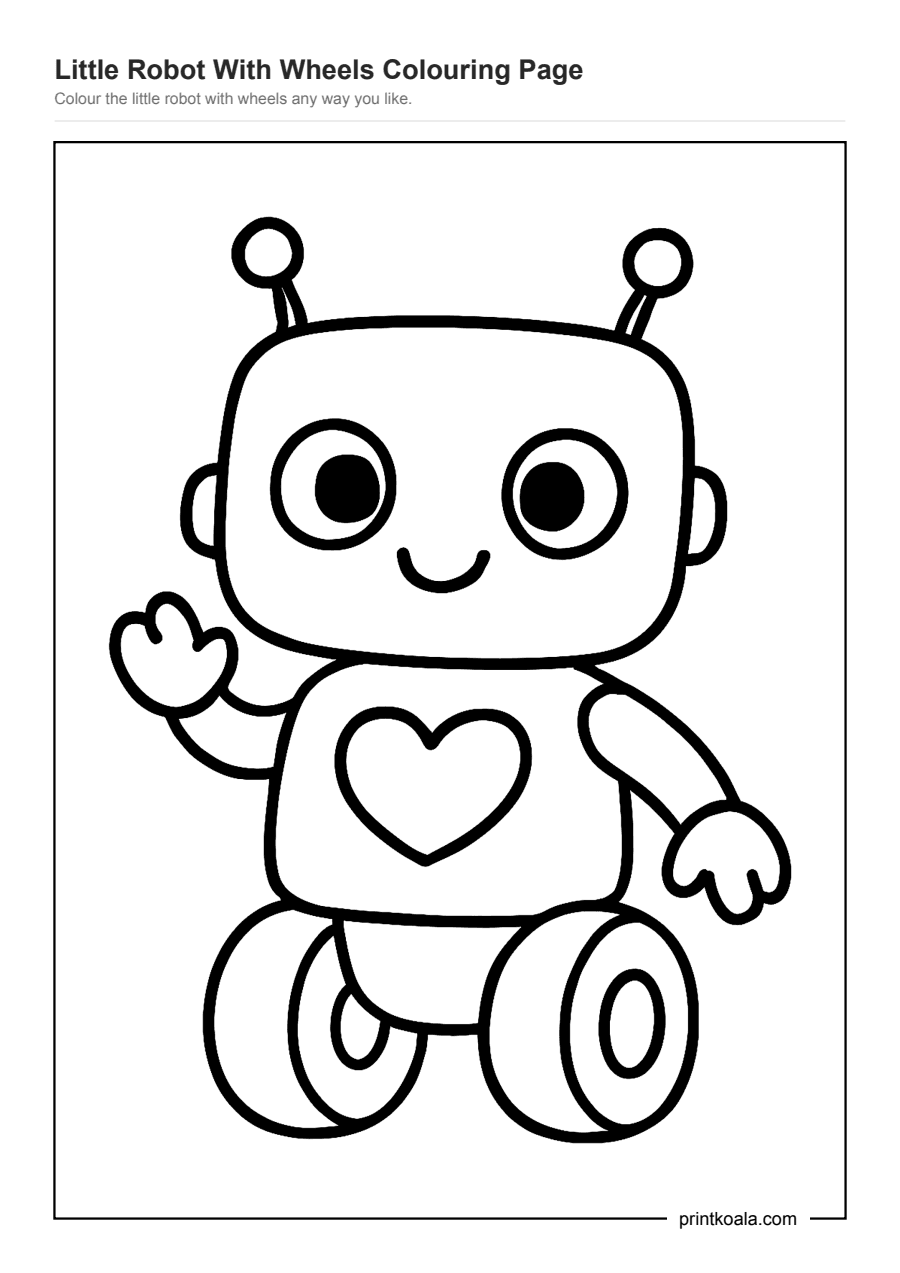
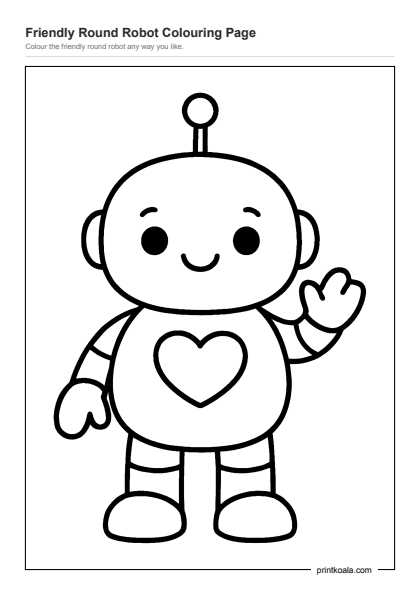
A round-headed robot waves hello with one hand, showing a big heart on its chest and two chunky wheels underneath.
Free, no sign-up. A4 · Print at 100% scale
This little robot stands facing forward with one arm raised in a wave and the other reaching down, fingers spread. Its square-ish head has two big round eyes, a curved smiling mouth, small bump ears on each side, and two antennae topped with round balls. In the middle of its chest sits one large heart, and below that a short waist band connects the body to two big wheels, each with a smaller circle inside like a hubcap.
Nearly every shape here is large and open, which makes this a good one for a child who is still getting used to holding a crayon steady. The head, the heart, and the two wheels are the biggest spaces and can each take a single bold colour without much care needed at the edges. The antenna balls, ears, and fingers are the only fiddly bits, so there is a nice mix of "easy and fast" and "slow down a little" in the same picture. It also gives you something to talk about while colouring: why is the robot waving, and why does it have a heart instead of buttons?
Compared to other sheets in this robot set, this one is on the simple side, with thick outlines and no small mechanical patterns to fill in. It suits toddlers and preschoolers just starting out with colouring, and it is a quick one to finish in a single sitting.
Start with the heart and head since they are the biggest, easiest shapes, then move to the wheels. Save the antenna balls and fingers for last, as they need a steadier hand. If a young child skips the small parts, that is fine.