🐙 Ocean & Sea Creatures
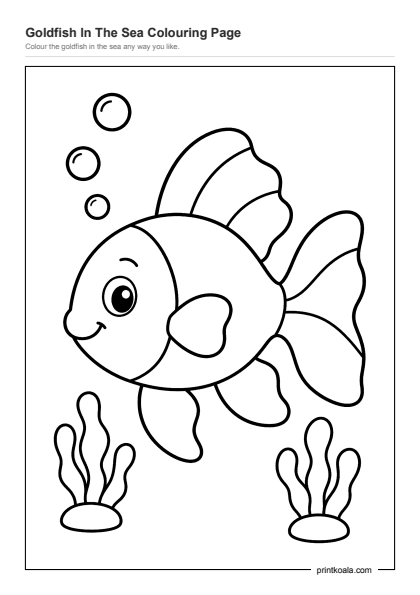
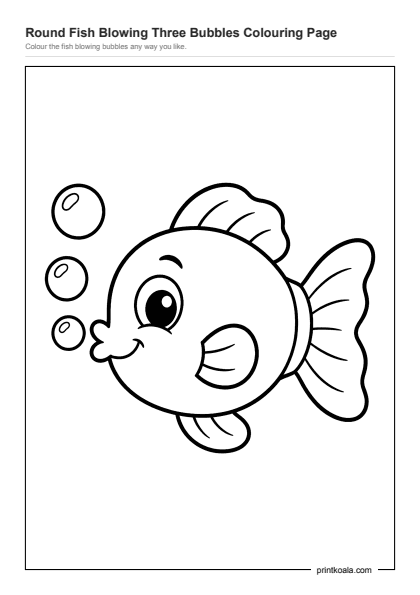
Round Fish Blowing Three Bubbles Coloring Page
Ages 2–512
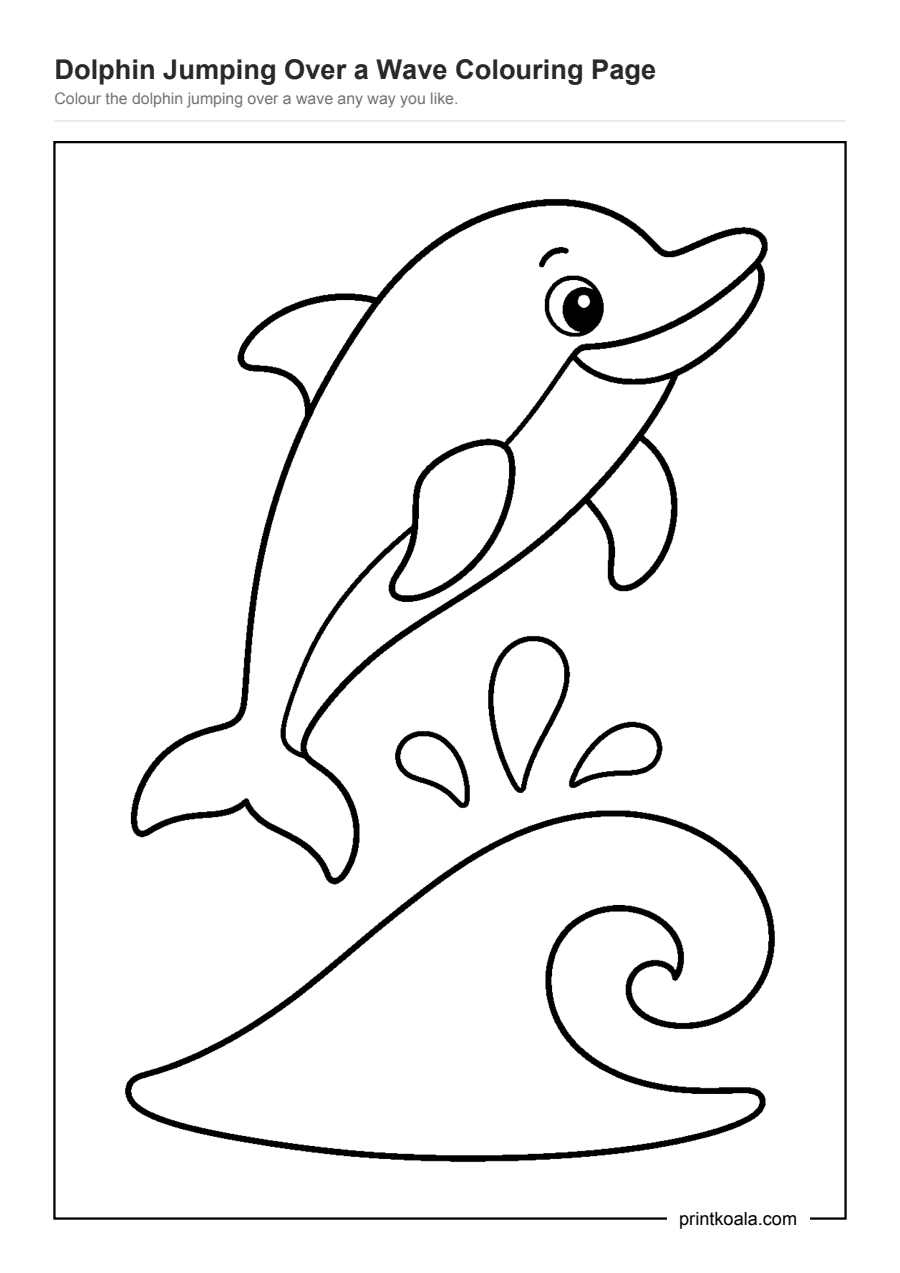
A grinning dolphin leaps out of a curling wave, with three splash droplets above the water and one big oval belly patch to fill in.
Free, no sign-up. Downloaded 8 times · A4 · Print at 100% scale
This dolphin is caught mid-leap, angled up and to the right, with its curved tail fin still pointing down toward the wave it just burst out of. It has one big smiling mouth, a single round eye, and a small curved line above the eye that gives it a happy, alert look. Along its body there is one large oval patch on the belly, a triangular dorsal fin on its back, a smaller pectoral fin on its side, and a two-lobed tail fin at the bottom. Just above the wave sit three separate teardrop-shaped water droplets, and underneath the dolphin the wave itself curls up into a tight spiral on the right-hand side before flattening out along the bottom of the page.
The body gives a child plenty of room to color in one broad sweep, especially the belly patch and the open stretch of the wave, which is good for early practice at staying inside a line without much pressure to be precise. The three droplets and the small fins are a different kind of task: each one is separate and fairly small, so a child has to stop and start rather than color in one long motion. The spiral curl of the wave is the fussiest part of the page, and it is worth pointing out to a child before they start, since it is easy to lose the line inside it. It is also a natural page for a bit of talk about jumping, splashing, and where a dolphin lives.
Nothing here is especially hard, but the mix of large open shapes and small tucked-away ones puts it a notch above the simplest sheets, which makes it a reasonable step up for a child who has outgrown very plain outlines. It suits preschoolers who can already stay roughly inside a line and are ready to try a shape with a bit more detail in it, rather than a first-time colorer.
Start with the belly patch and wave, the biggest open spaces, before moving to the smaller fins and droplets. The wave's spiral curl is the trickiest bit, so point it out first. If a child colors over a line, treat it as part of the splash rather than a mistake.