🦄 Fantasy & Fairy Tale
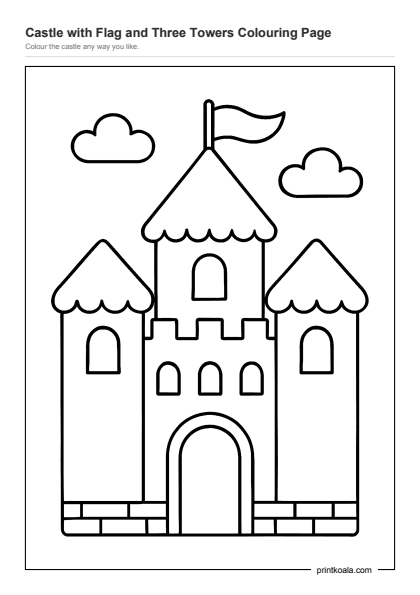
Castle with Flag and Three Towers Coloring Page
Ages 2–511
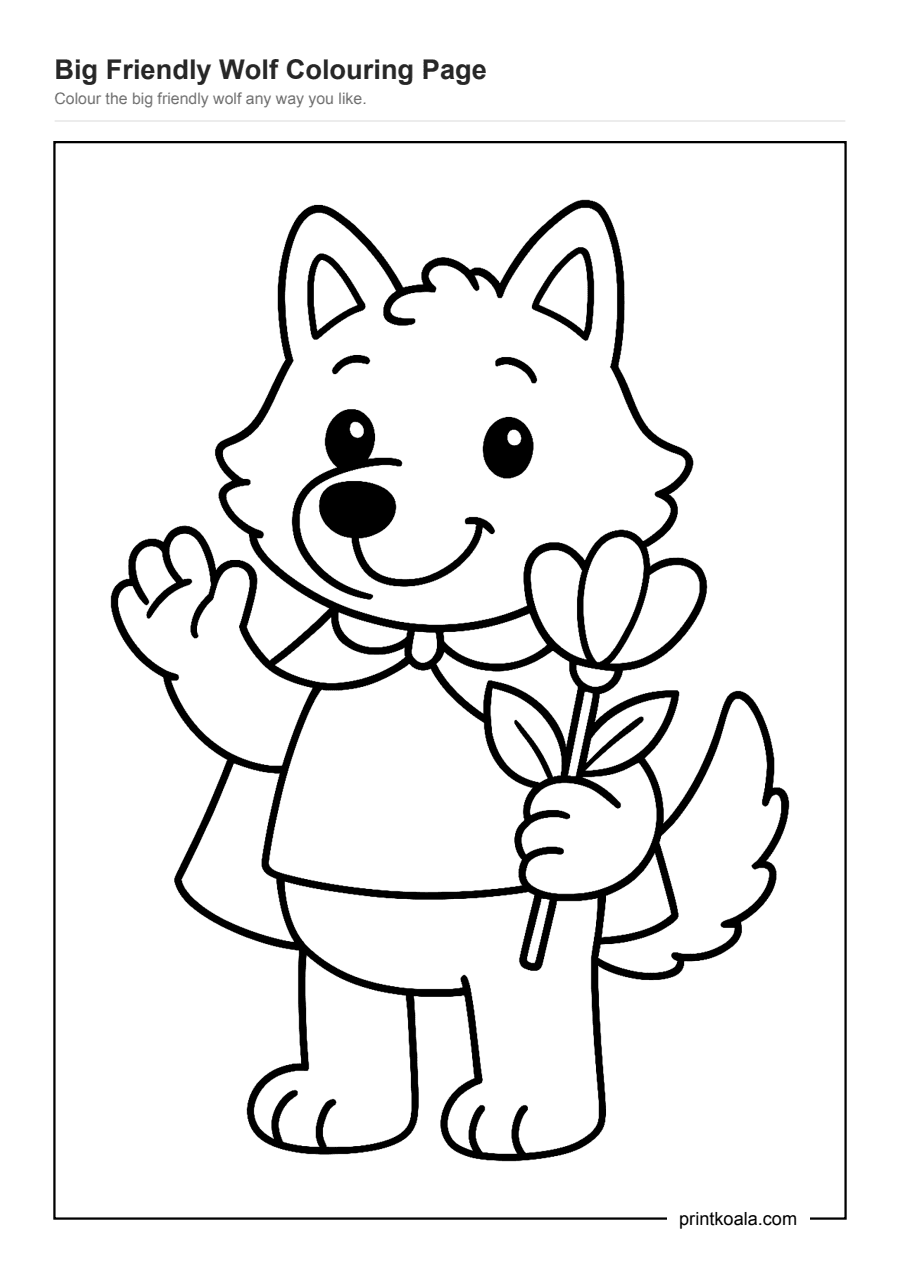
A wolf stands on two legs, waving one paw and holding a big tulip in the other, cape tied round his neck.
Free, no sign-up. Downloaded 8 times · A4 · Print at 100% scale
This wolf stands upright like a little person, not on all fours. One paw is raised in a wave, fingers spread, and the other paw holds the stem of a single large tulip with two pointed leaves. He wears a short cape with a rounded collar, tied loosely at the neck, over a plain round tunic and stubby legs with paw-pad feet. His face takes up most of the head: two big pointy ears, a fluffy tuft between them, round eyes with a white highlight dot in each, a small triangle nose and a wide open smile. A bushy curled tail pokes out from behind the cape.
Nothing on this page is fiddly. The tunic, the cape and the tail are each one big open shape a child can fill in with a single color and barely have to lift the crayon. The flower gives a reason to swap colors partway through, since the petals, leaves and stem are all separate small areas. The face invites a chat too — ask what color the eyes should be, or whether this is a red-cape wolf or a blue-cape one, and why he is smiling and waving instead of looking scary.
There is nothing here that will frustrate small hands: no tight corners, no crosshatching, no background clutter to work around. That makes it an easy, low-pressure sheet, good for a child who is still building the patience to stay inside a line, or for a quick print when you just want ten calm minutes with a crayon box. Older preschoolers who like more detail may finish it fast and ask for a second sheet.
Start with the big tunic and cape so your child gets an early win, then move to the flower for the fiddlier bits. If the small petals feel too tricky, it is fine to color them as one block rather than separating each one.