🐄 Farm Animals
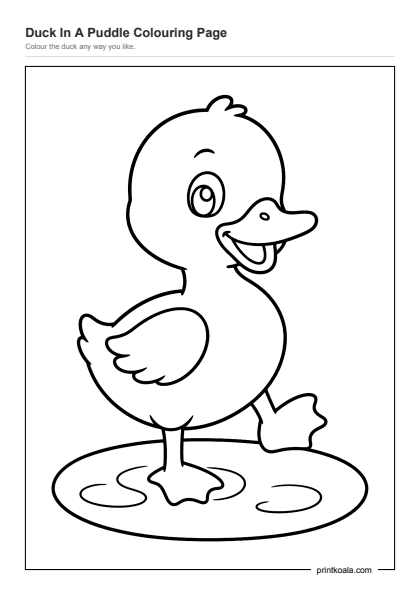
Duck in a Puddle Coloring Page
Ages 2–516
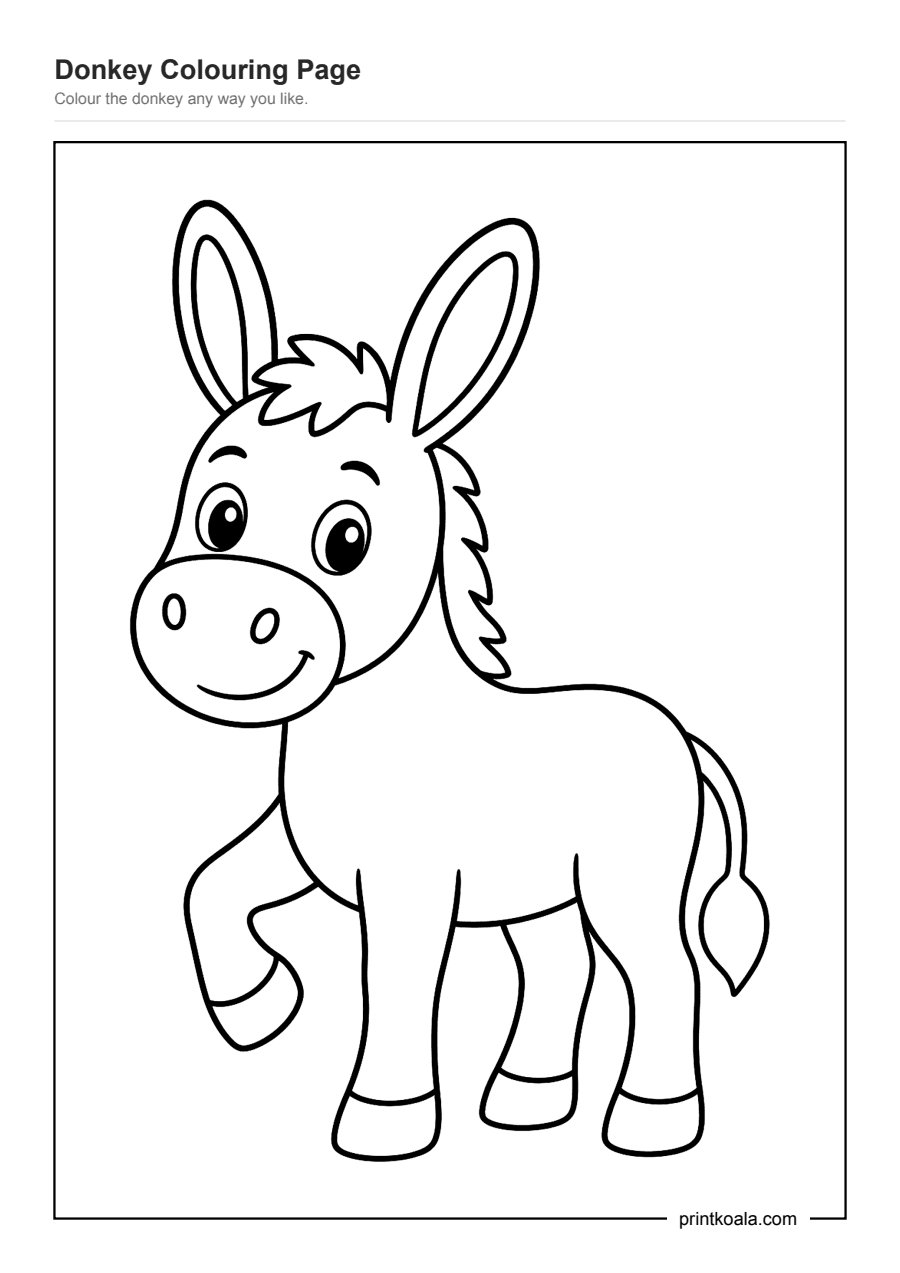
A friendly donkey stands with one front hoof lifted mid-step, big tall ears and a spiky mane ready to color.
Free, no sign-up. Downloaded 11 times · A4 · Print at 100% scale
This donkey stands side-on with its head turned to face you, one front leg bent and lifted as if it has just taken a step. Two tall, pointed ears stand up above a tuft of spiky mane between them, and more jagged mane runs down the back of the neck to a long tail with a tufted end. The face has two round eyes with high arched brows, a big rounded muzzle with two nostrils, and a closed, gently smiling mouth. All four hooves are marked with a simple band near the tip, and the body is drawn as one broad, open shape from shoulder to flank. There is no background, just the donkey alone on the page.
The body, ears and muzzle are large open spaces a young child can fill in with big, sweeping strokes without worrying about staying inside tiny lines. The mane, tail tuft and hoof bands are smaller and more jagged, so they are a natural place to try a second or third color once the big shape is done. The raised front leg gives the donkey a sense of movement, which is worth pointing out to a child before they start: ask them which leg is stepping and which three are on the ground.
This is an easier sheet than most in the farm animals set, with no fencing, straw or background clutter to work around. It suits a child who is still building control over a crayon or thick marker, and it also works fine for an older preschooler who wants to move fast and add extra colors to the mane and tail.
Start with the big body shape before the mane and tail, so early wobbles get covered by a confident color rather than left as bare white patches. If the mane looks fiddly, one flat color there is fine.