🚀 Outer Space
Galaxy Swirl Coloring Page
Ages 2–46
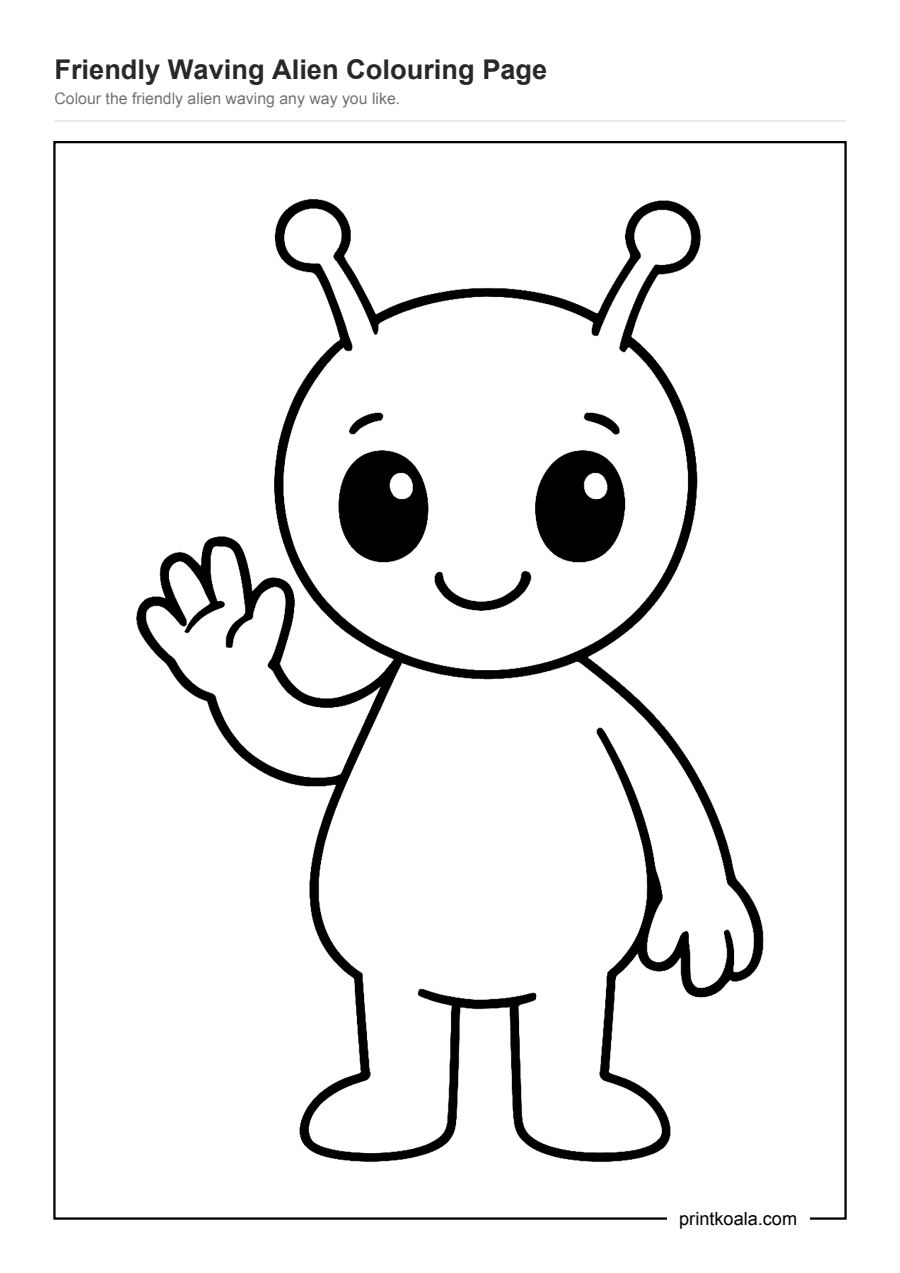
A round-headed alien with two ball-tipped antennae waves hello with one hand, standing alone on a plain page.
Free, no sign-up. Downloaded 5 times · A4 · Print at 100% scale
This alien stands facing forward with a big round head and a soft, rounded body that tapers into two short legs and oval feet. Two thin antennae stick up from the top of its head, each ending in a small round ball. Its face has two large oval eyes with a tiny white highlight dot in each, small curved eyebrows, and a simple curved smile. One arm is raised in a wave, fingers spread out, while the other hangs down at its side. There is nothing else on the page: no stars, no spaceship, no ground line, just the alien standing in the middle of white space.
That empty background is what makes this one easy to hand over. The head and body are big open shapes a child can fill with one color in broad strokes, good practice for staying inside a large curved line without much fuss. The antennae balls, the eyes, and the waving hand are smaller and will need a steadier hand or a finer crayon tip, so the page naturally offers both an easy win and a bit of a challenge in the same drawing. It is also a nice one to talk through: ask what color an alien's skin might be, or why it is waving, and let the answer decide the page.
Because the shapes are large, the lines are thick, and there are no small background details to fuss over, this sits at the easy end of the sheets in the Outer Space set. It suits younger colorers who are still working on control, and it also works as a quick, low-pressure page for an older child who wants something finished fast.
Let your child start with the big body and head first, then move to the smaller antennae tips and waving hand once they have their rhythm. If the fingers feel too fiddly, coloring the whole hand as one shape is fine.