🐄 Farm Animals
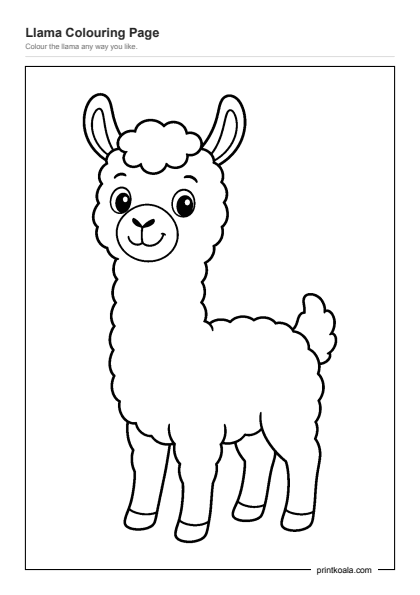
Llama Coloring Page
Ages 2–539
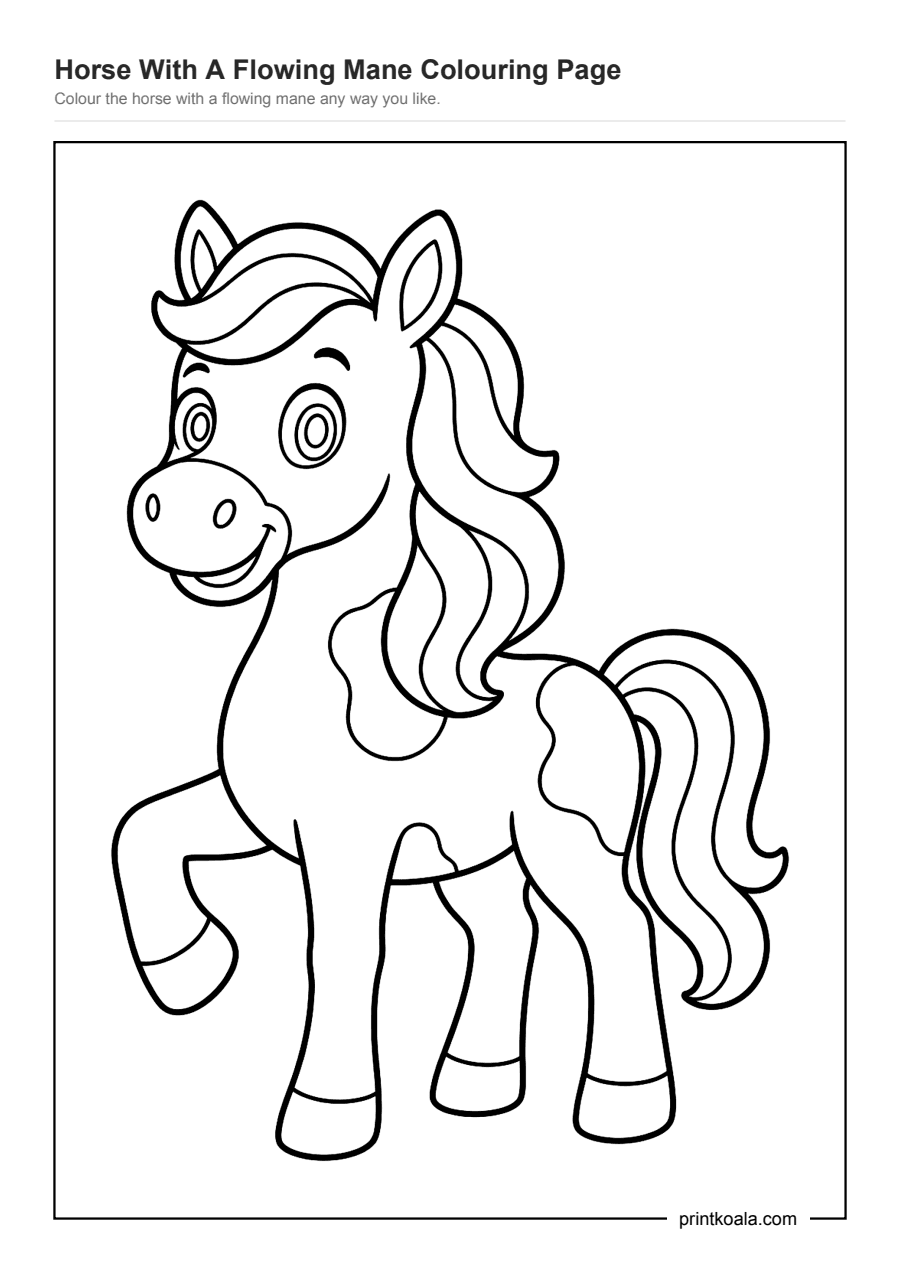
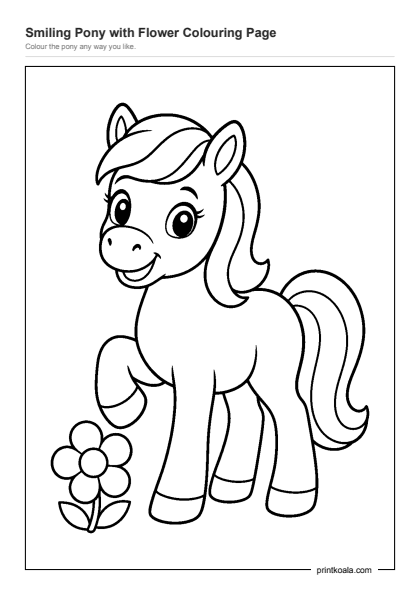
A smiling cartoon horse stands on three legs with one front hoof raised, its long wavy mane and tail curling down its neck and back.
Free, no sign-up. Downloaded 12 times · A4 · Print at 100% scale
This horse stands mid-step with one front hoof lifted off the ground, looking out at the viewer with a big grin and round eyes. Its forelock swoops down over the forehead in a curl, and from there a long, wavy mane tumbles all the way down the neck and across the back, ending in a tail that curls into loops behind it. Two irregular patches sit on the body, one near the shoulder and one on the hip, and each of the four hooves wears a plain cuff line near the bottom. There is no background, just the horse on white space, so nothing competes with it for attention.
The mane and tail are the main event here. They are drawn as broad, connected waves rather than individual hairs, so a child can run one color through the whole length without hunting for edges or stopping at awkward corners. The body is one large open shape too, apart from the two patches, which give a child the choice of leaving them a different color or blending them in. The raised front leg breaks up what would otherwise be a very symmetrical standing pose, and it is a good thing to point out and talk about: is the horse trotting, waving a hoof, about to take a step.
Everything on this page sits inside generous, well-separated lines, with only the eyes, nostrils and hoof cuffs asking for any small, careful strokes. That makes it a gentle sheet overall, suited to a child who is still building control over a crayon or who wants a picture they can finish without help. Older preschoolers who like more to do can use the mane and tail as a chance to switch colors several times rather than treating it as a one-color job.
Start with the mane and tail since they are the biggest, easiest shapes to fill in one go. Save the eyes, nostrils and hoof cuffs for last, as they are the fiddliest parts. If your child colors outside a line, let it go; the broad shapes mean it barely shows.