🐄 Farm Animals
Smiling Pony with Flower Coloring Page
Ages 3–517
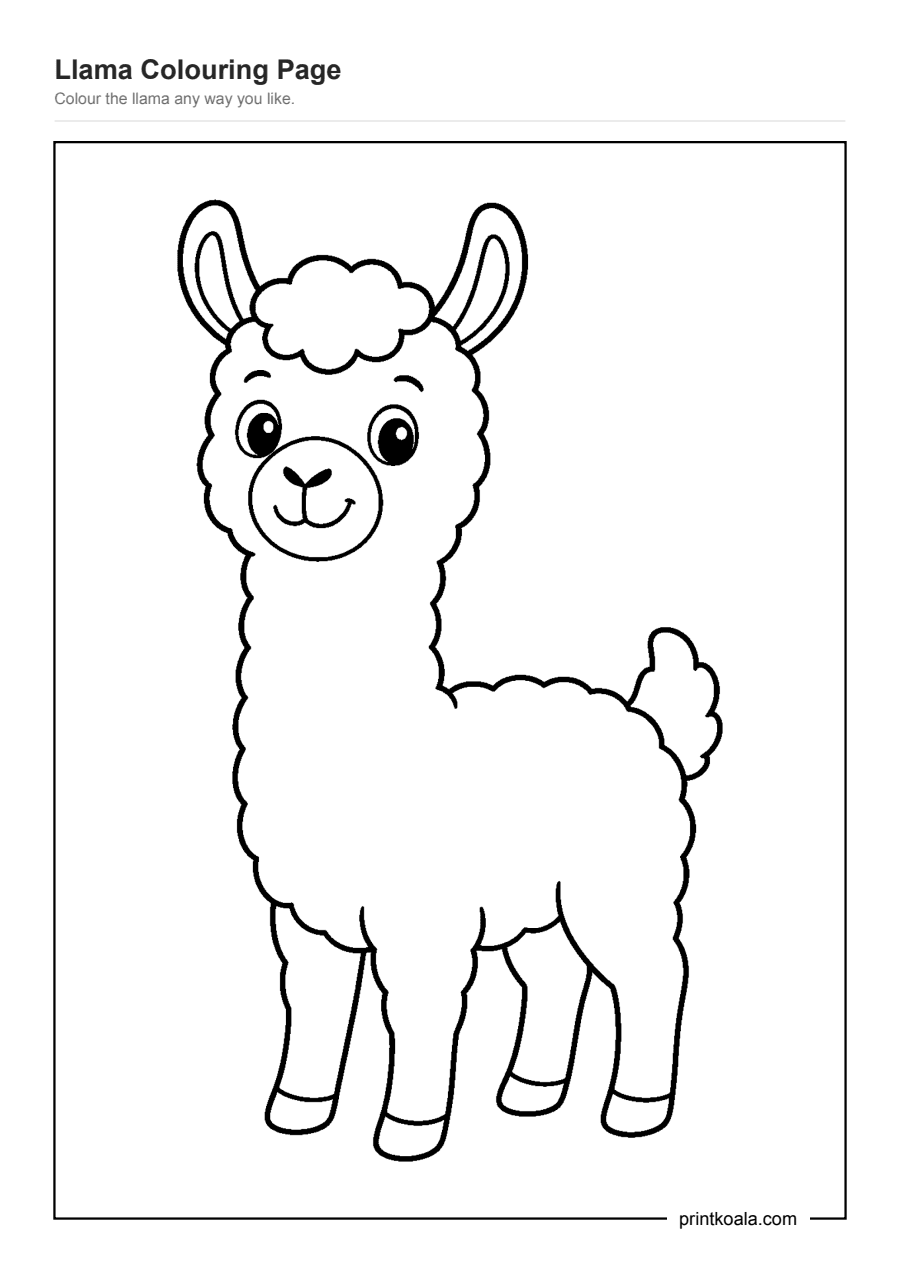
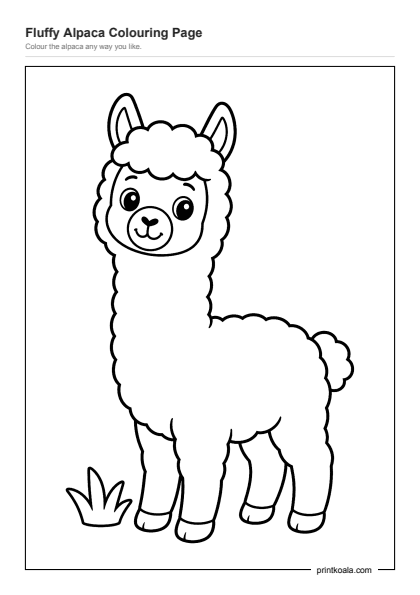
A friendly llama stands facing forward with a fluffy topknot, curled tail and four sturdy legs, all in bold, simple outlines.
Free, no sign-up. Downloaded 39 times · A4 · Print at 100% scale
This llama stands square to the viewer, its head tilted just slightly forward, two tall pointed ears standing up and a soft, scalloped tuft of wool sitting on top like a fringe. The face has two big round eyes, small arched eyebrows above them, and a rounded muzzle with a little nose and a gentle smile. Its long neck and body are edged with a bumpy, scalloped line that stands in for wool, and a small curled tail pokes out at the back. All four legs are straight and evenly spaced, each one finishing in a plain hoof marked by a single line. There is nothing else on the page: no background, no fence, no grass, just the llama itself.
What makes this one worth printing is the size of the spaces. The neck and body are big open shapes a child can fill in with one color and barely need to lift the crayon, which is a relief after a page full of fiddly patterns. The scalloped wool edge and the ears give a bit of shape to follow without asking for careful work, and the two eyes and small nose are really the only spots that call for a steadier hand and a finer tip. It is an easy page to talk about while coloring, too: how many legs does it have, where is its tail, is the wool fluffy or smooth.
Next to other sheets in the Farm Animals set, this is one of the gentler ones. The clean, wide-open body shape suits a two or three year old just getting used to holding a crayon inside a line, while the small facial details give a four or five year old something to slow down for. There is no shading or crosshatching anywhere on the page, so nobody needs to be precise to make it look finished.
Let your child start with the big body and neck first, since one color fills most of the page. Save the eyes and nose for last, when their hand is warmed up, and do not worry if the wool edges get some color on the white background.