🎈 Animals Having Fun
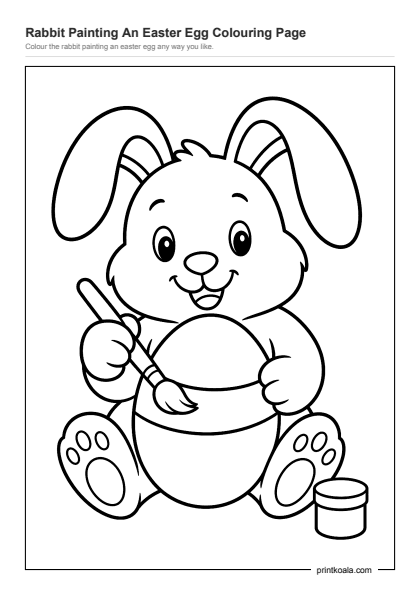
Rabbit Painting an Easter Egg Coloring Page
Ages 2–51
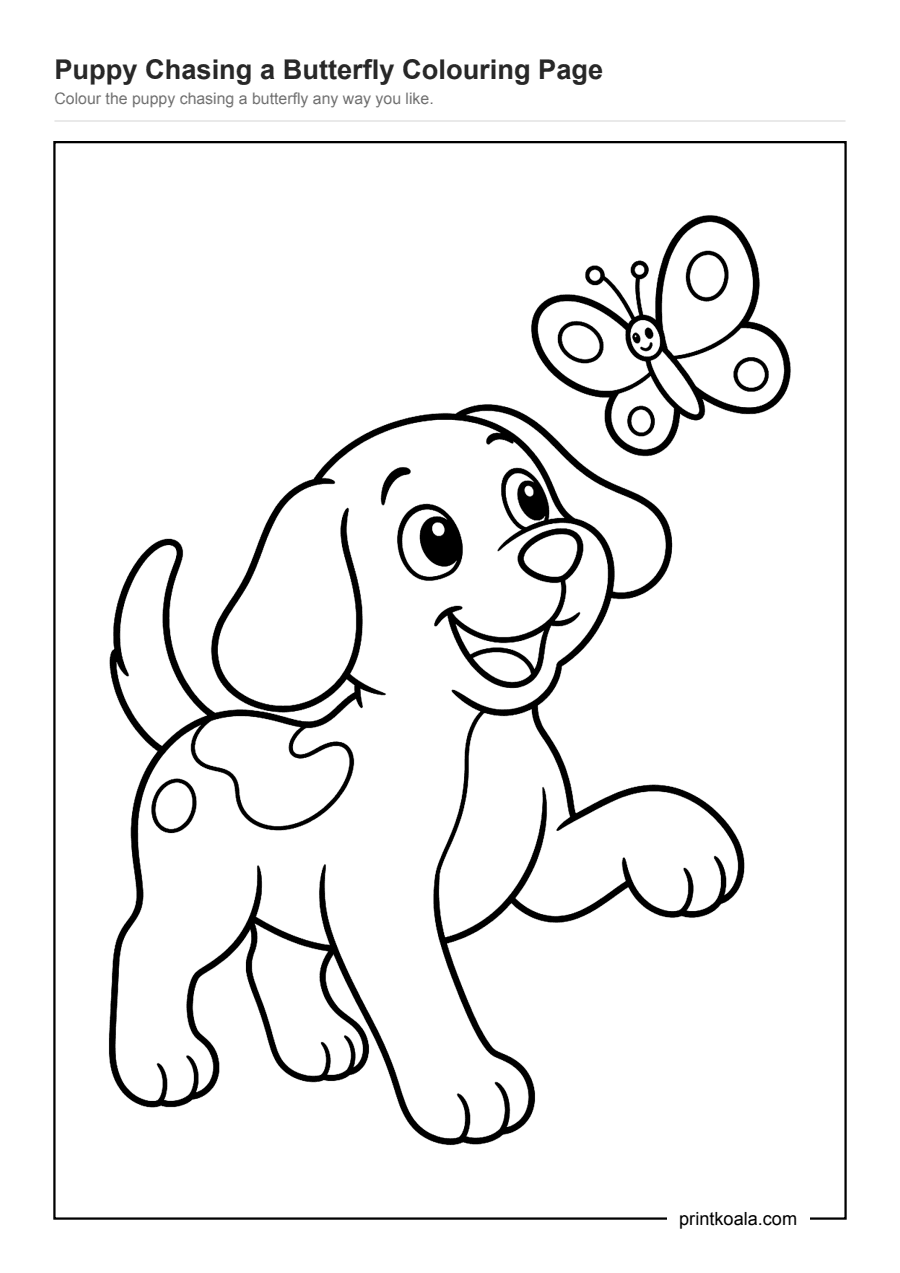
A grinning puppy rears up on its back legs, one paw raised, to look up at a big butterfly hovering just out of reach.
Free, no sign-up. Downloaded 7 times · A4 · Print at 100% scale
This puppy has stopped mid-chase. It stands up on its back legs with one front paw lifted, head tipped back, mouth open in a wide happy grin, watching a large butterfly hover above its nose. One ear flops down over its face and the other peeks up behind it. The tail curls up in a loop. Down its side are two dark patches, one big irregular one near the shoulder and a small round spot near the back leg. The butterfly itself is drawn oversized, with two curled antennae ending in little round tips and a circle on each of its four wings, plus a tiny smiling face in the middle.
There is a lot here for small hands to get through without much fiddly work. The puppy's body, ears and the butterfly's wings are all big, closed shapes that take color easily, so a child can fill most of the page with a single crayon and still see the picture come together fast. The two body patches and the four wing circles are the only places asking for a careful hand, which makes a nice change of pace once the big areas are done. It is also a good page for talking about why a dog might chase a butterfly, and why the butterfly always seems to win.
This sits on the easier side for a page with two characters on it. The line work is clean and the shapes are generous, so most preschoolers can manage it without help, while the small spots and antennae give slightly older children something to slow down for. It suits a child coloring alone as much as one doing it alongside a grown-up.
Let your child start with the puppy's body, since it is the biggest space, then move to the butterfly. Save the small wing circles and body patches for last, when their hand is warmed up. Talk about what the puppy is looking at as you go.