⚽ Sports & Fun Activities
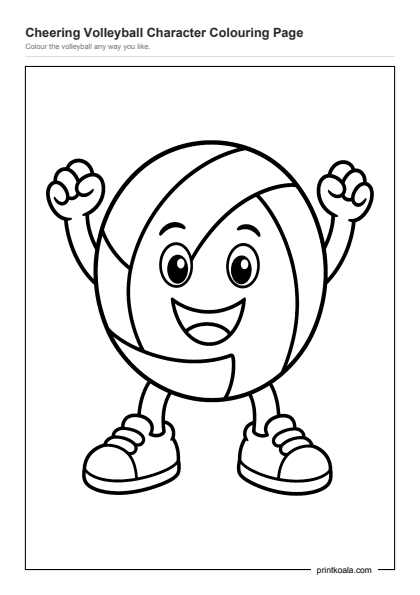
Cheering Volleyball Character Coloring Page
Ages 3–54
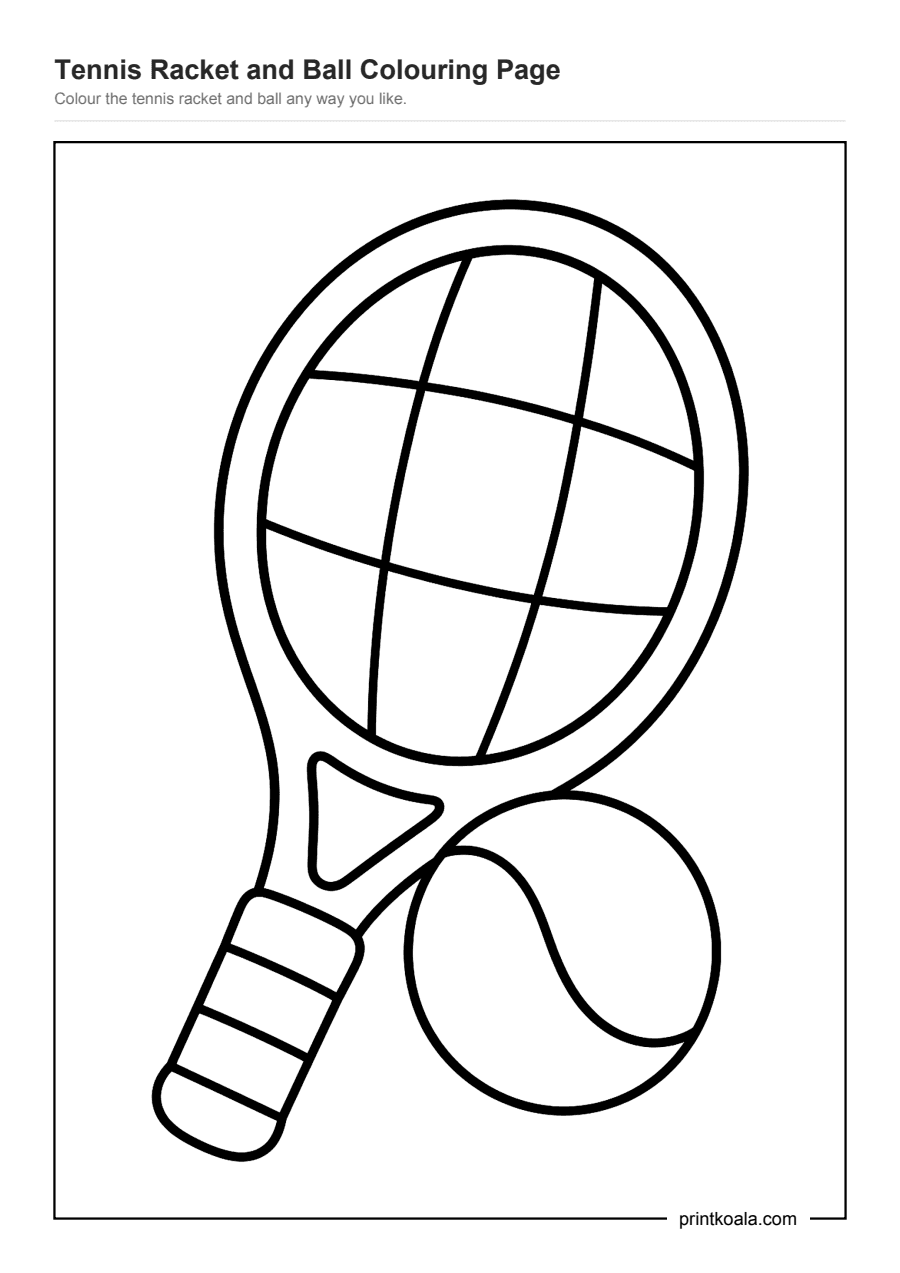
A tilted tennis racket with a crisscross-strung head overlaps a big round ball marked with a single curving seam.
Free, no sign-up. Downloaded 9 times · A4 · Print at 100% scale
This sheet shows one tennis racket leaning on a diagonal, head up, with a big oval frame and strings drawn as crossing lines that carve the middle into eight or so slanted panels of different sizes. Where the head meets the handle there is a small triangular bridge piece, and the handle itself is marked off into four stacked grip bands before it rounds off at the bottom. Tucked in front of the handle, overlapping the frame, sits one large tennis ball with a single wavy seam curving across it and splitting it into two halves.
The ball is the easiest part of the page: one wide, unbroken curve to stay inside, and a child can fill each half in a different color or keep it all one shade of green or yellow. The racket asks for a bit more care, because the strings break the head into several smaller angled patches rather than one open space, so little hands will need to slow down and switch direction more often. The grip bands are a nice change of pace after that — four short, straight-edged stripes that go quickly and are easy to alternate in color.
It sits in the middle of the difficulty range for this age group: not a fussy, detail-heavy drawing, but the strung head has enough small sections that a three-year-old may need help or lose interest partway through, while a four- or five-year-old can manage the whole thing independently. It suits a child who already has some coloring practice and is ready for a page with more than one type of shape on it.
Start with the big ball, since it is the easiest shape, then move to the handle stripes. Save the strung center of the racket head for last, as its smaller panels need the steadiest hand and a bit of patience.