🐶 Pets
Stepping Turtle Coloring Page
Ages 2–410
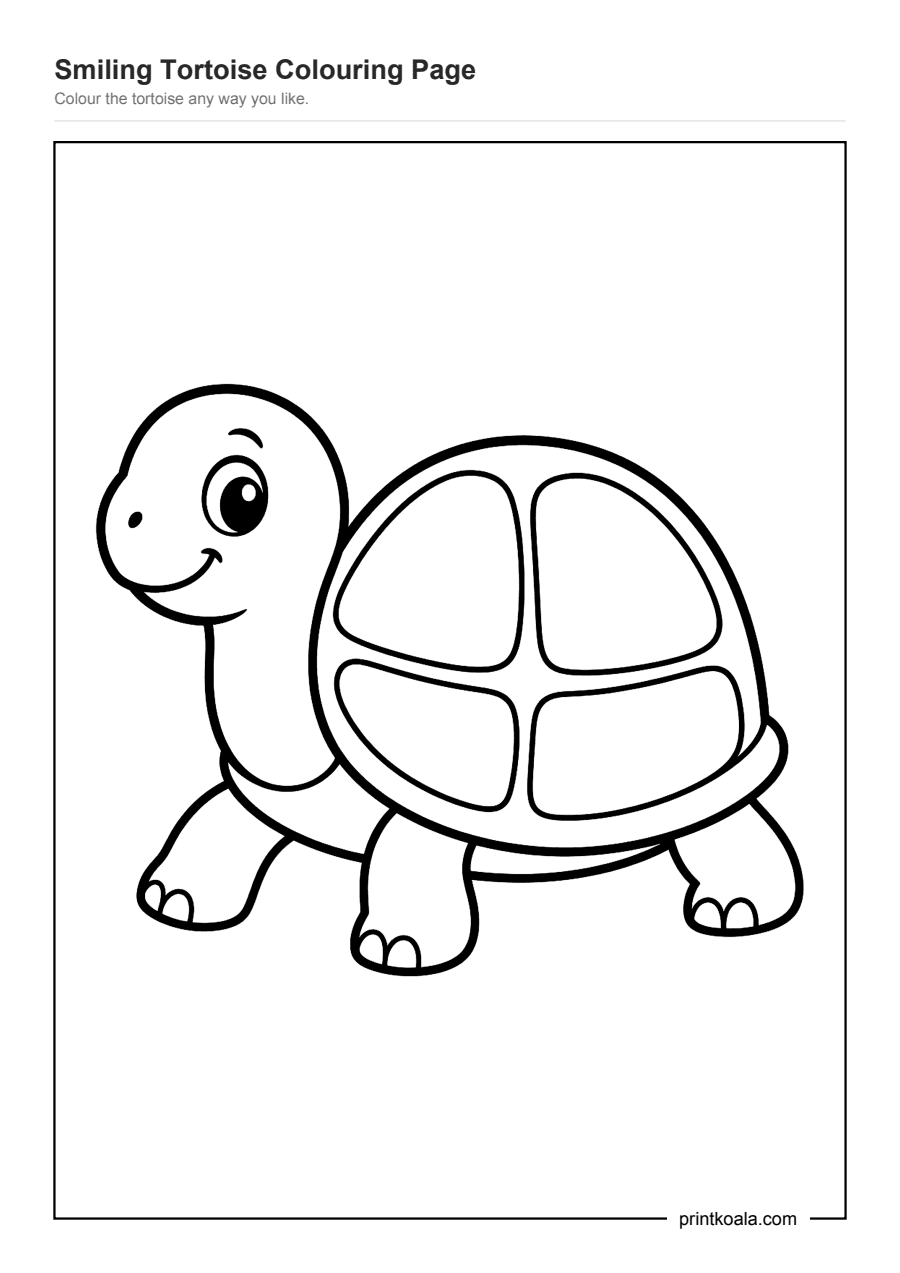
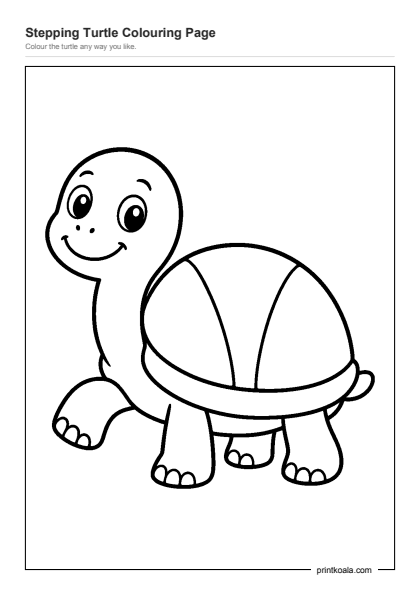
A cheerful tortoise strolls on four sturdy legs, its domed shell split into four big panels ready to color.
Free, no sign-up. Downloaded 13 times · A4 · Print at 100% scale
One tortoise fills the page, walking to the left on four thick legs, each foot marked with two small claws. Its neck stretches up and out from the shell, ending in a round, smiling face with one big oval eye, a curved eyebrow and a tiny dot for a nostril. The shell itself is the star of the drawing: a tall dome divided by a cross into four large panels, with a plain curved band running round the base where the shell meets the body. There is no background, grass or pond here, just the tortoise on its own, so nothing competes for attention.
The four shell panels are the main event, and they are big enough that a three-year-old can color inside the lines without much trouble, whether they pick one color for the whole shell or a different shade for each panel. The face is small and asks for more care, especially the eye and the thin eyebrow line, so it is a nice spot to slow down and use a finer stroke or a pencil instead of a chunky crayon. The legs and claws give a few smaller shapes to break up all that open shell space, which keeps the page from feeling like one big empty circle.
This is an easy sheet, better suited to younger colorers who want quick, satisfying results than to children hunting for a challenge. The wide shell panels forgive wobbly lines, while the face offers just enough detail to keep older preschoolers interested too. It works well as a first go at coloring an animal with a shell, or as a calm, low-pressure page for the end of a busy day.
Let your child start with the four shell panels since they are the biggest, easiest spaces, then move to the face last where the lines are finer. If the eye proves fiddly, a thin pencil works better than a crayon. Ask them what color a real tortoise shell might be.