🦄 Fantasy & Fairy Tale
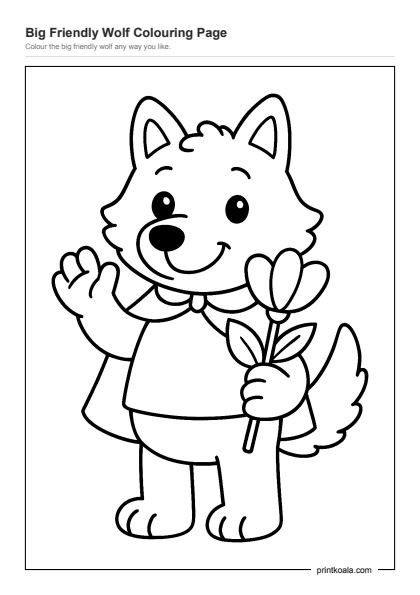
Big Friendly Wolf Coloring Page
Ages 2–48
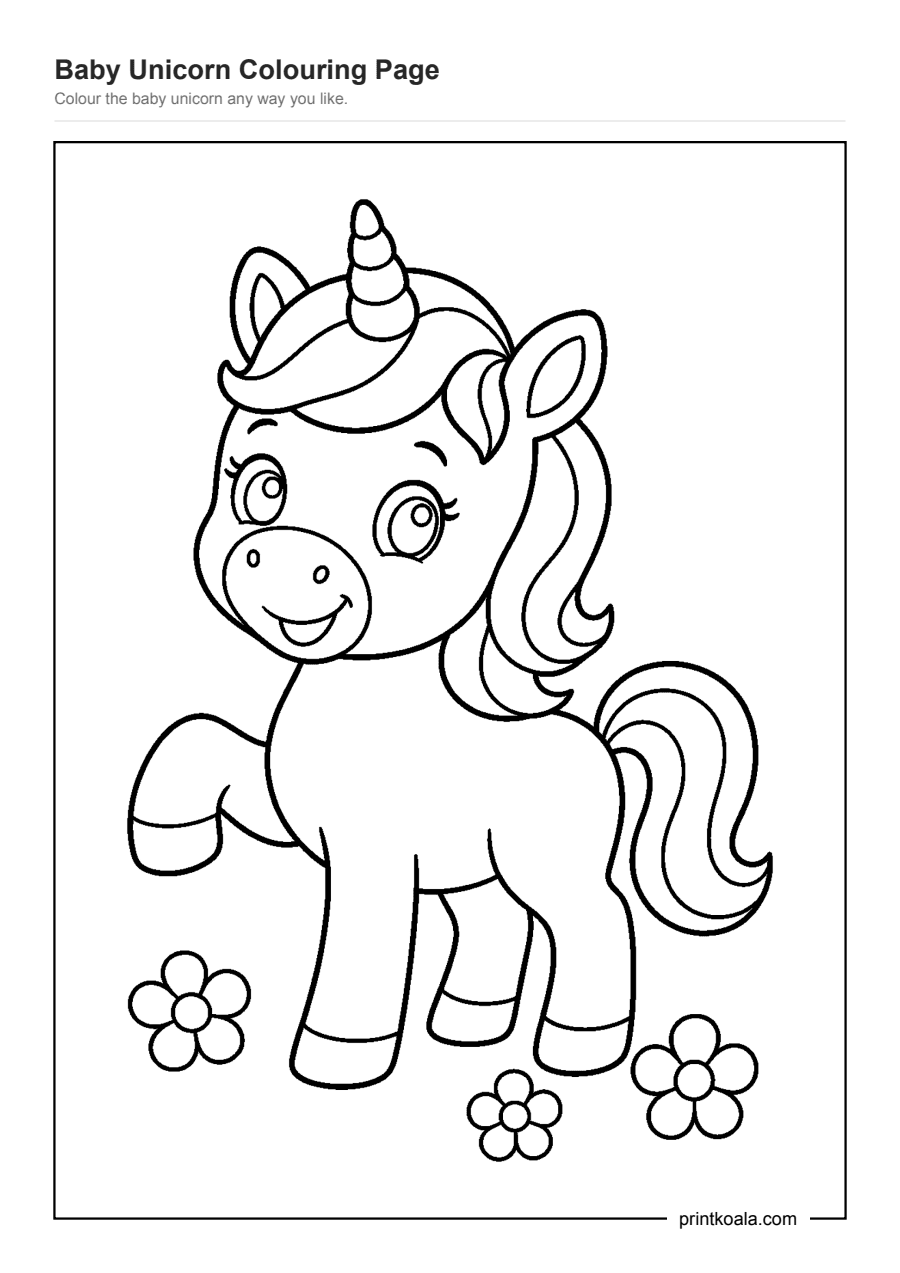
A smiling baby unicorn steps forward with a swirly mane and curled tail, surrounded by three simple flowers to color.
Free, no sign-up. Downloaded 3 times · A4 · Print at 100% scale
This baby unicorn stands with one front hoof lifted mid-step, head turned slightly to smile straight out of the page. It has a short spiral horn with ridged bands, big round eyes with long lashes, and a wavy mane that spills down over one shoulder. The tail curls into two big loops behind it, and each hoof has a plain band near the tip, like a little cuff. Down at ground level, three five-petalled flowers sit scattered around its feet, each with a round center.
The body, legs and mane are drawn in large, simple shapes, so a child can color the unicorn itself in a few broad strokes without much fuss. The horn's ridge lines, the lash-topped eyes, and the flower petals are smaller and closer together, which asks for a slower hand and a bit more care to keep color inside them. It is an easy picture to talk about while coloring: what color should the mane be, should the tail match, should every flower be the same or different.
There is nothing tricky in the layout and no crowded background to fight with, so this suits a child just starting out with coloring as much as one who wants an easy, satisfying sheet after a harder one. Younger children can stick to the big shapes and skip the horn detailing altogether; older preschoolers who like to fill in every line will find just enough small parts here to keep their interest without wearing them out.
Let your child start with the big body shape before moving to the smaller horn and eye details, which take more control. If the horn bands feel fiddly, skip them and come back at the end, or leave the horn a single color.