🚒 Community Helpers
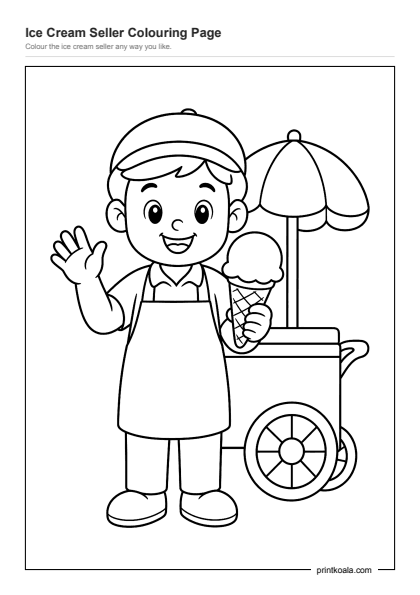
Ice Cream Seller Coloring Page
Ages 2–55
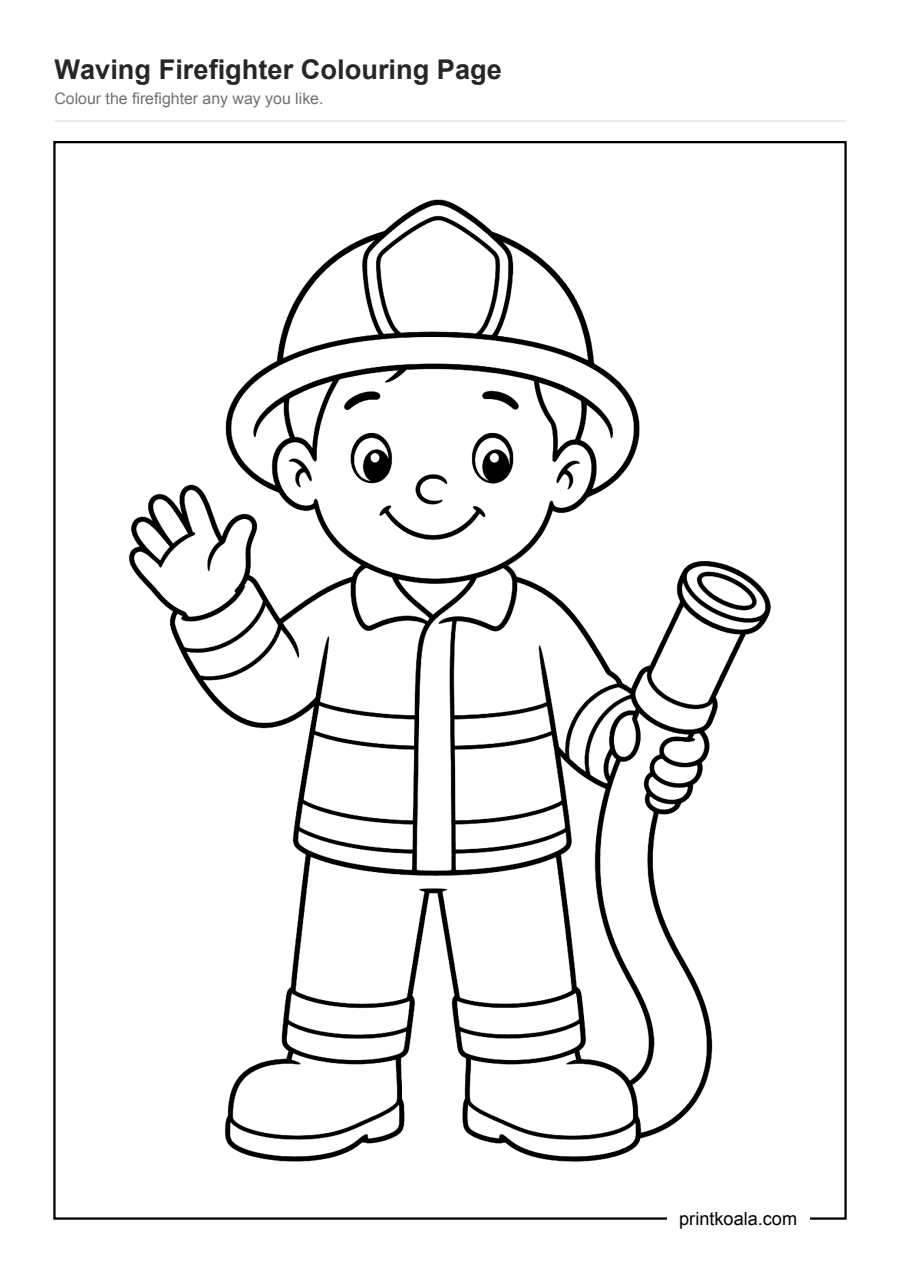
A smiling firefighter in helmet and jacket waves hello while holding a coiled fire hose in his other hand.
Free, no sign-up. Downloaded 10 times · A4 · Print at 100% scale
This firefighter stands facing forward in his full kit: a rounded helmet with a badge on the front, a jacket with a turned-down collar and a stripe across the chest, trousers with a stripe near the ankle, and two chunky boots. His left hand is up in a wave, fingers spread wide, and he's grinning with a round, friendly face. His right hand grips a coiled fire hose, the nozzle held out with two rings marking the opening, the rest of the hose looping down behind his boot to the ground.
The picture is built mostly from big, generous shapes, so most of a first attempt can be spent on the helmet, jacket and boots without a child needing to stay inside anything fiddly. The waving hand and the hose nozzle are smaller and give slightly trickier edges for a child who wants more of a challenge, and the stripe bands on the jacket and trousers are a natural spot to try a second color against the main uniform color. It's also a picture that invites a bit of talk while coloring: what color a real fire helmet is, why the boots are so thick, what the hose is for.
There's nothing frightening here, no fire or smoke, just a friendly helper saying hello, which makes it a comfortable pick for a first "jobs people do" sheet. The mix of large uniform pieces and a few smaller detailed bits, like the fingers, badge and hose rings, keeps the overall level easy, doable by a three-year-old with help and still satisfying for a five-year-old who wants to work carefully on the small parts.
Start with the helmet and jacket, the biggest shapes, so your child gets a quick sense of progress. Save the waving hand and hose nozzle for last, since the smaller edges there take more patience and are easier with a fine-tipped crayon or marker.