🌈 Nature & Weather
Sunny Day Coloring Page
Ages 2–416
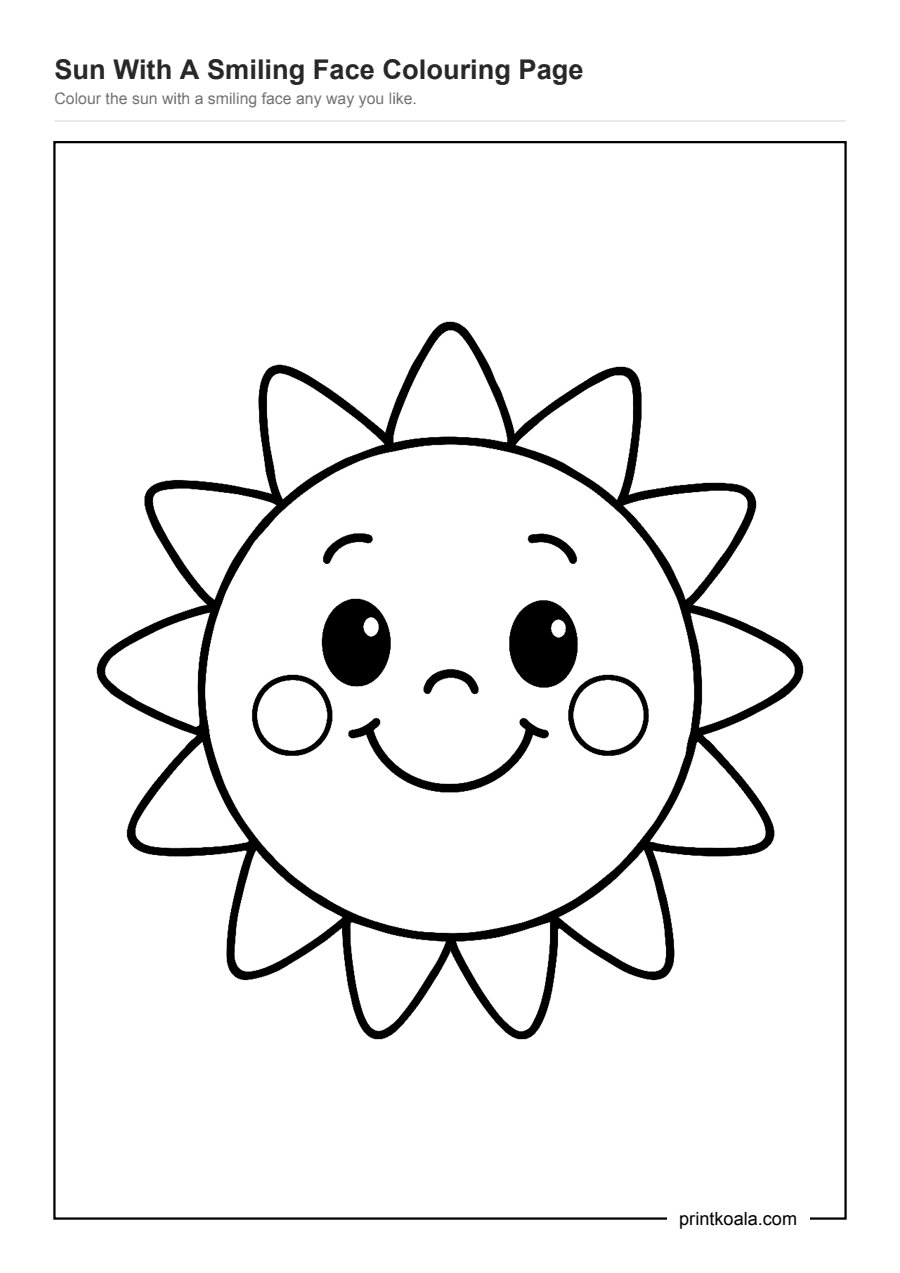
A big round sun with a happy face, curved eyebrows, round rosy cheeks and twelve pointed rays to color.
Free, no sign-up. Downloaded 6 times · A4 · Print at 100% scale
This page is one large sun, drawn front-on, filling almost the whole sheet. The round face has two curved eyebrows, two wide eyes with a little white sparkle left blank in each, a small curved nose, a smiling mouth, and two round rosy cheeks sitting just below the eyes. Around the face are twelve pointed rays, evenly spaced like the petals of a flower, each one a long simple triangle shape. There is nothing else on the page: no clouds, no sky, no ground, just the sun and its rays.
That simplicity is the whole point. The rays are long and wide, so a child can color each one in a single stroke without worrying about staying inside tight lines, and there are twelve of them, which is a nice excuse to reach for several different crayons and make a pattern, or to keep it classic and go all yellow and orange. The cheeks are small circles, which give a bit more of a fine-motor challenge if your child wants to shade them a different color from the rays. It is an easy page to talk over while coloring, too. Ask why the sun looks happy, or what color a sun really is.
Because the shapes are so large and there is only one subject on the page, this is one of the easier sheets in the Nature & Weather set. It suits younger colorers who are still working on staying inside bigger areas, and it also works as a quick, low-pressure page for an older child who just wants something cheerful to finish in one sitting.
Let your child start with the rays, since each one is a single easy stroke, then move to the face last, where the smaller cheeks need more care. If crayon strays outside a ray, just call it a sunbeam and keep going.