🌈 Nature & Weather
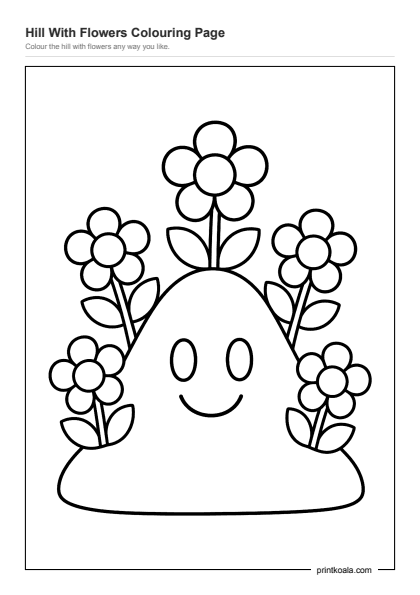
Hill with Flowers Coloring Page
Ages 2–54
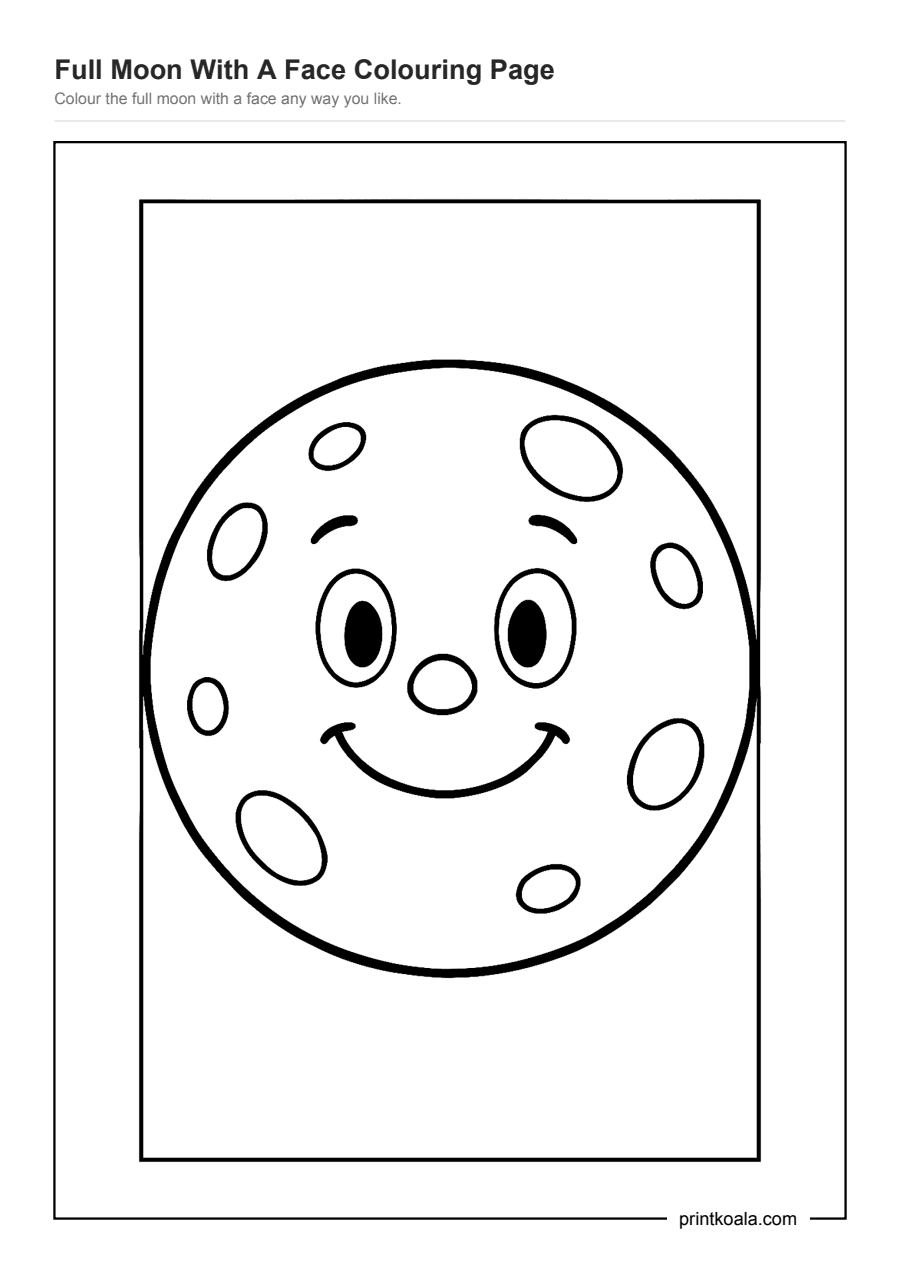
A big round smiling moon with eight scattered oval craters of different sizes, ready to color.
Free, no sign-up. Downloaded 9 times · A4 · Print at 100% scale
The page shows one large moon, drawn as a big circle that fills almost the whole portrait sheet. Its face is already smiling: two solid black oval eyes, a small round nose, two short curved eyebrows and a wide curved mouth are all printed in place. Around the face, eight oval craters of different sizes are scattered evenly across the moon's surface, leaving plenty of plain space between them for coloring.
Because the eyes and eyebrows are already filled in, your child's job is simpler than it looks: color the wide round body of the moon, then find and fill in each of the eight craters. The big circle gives lots of room for sweeping strokes with barely any risk of crossing a line, while the craters offer a change of pace, small ovals that ask for a slower, more careful hand. It is a natural moment to talk about night time, the sky outside, and why the moon looks the way it does.
With one dominant shape, wide gaps between the craters and no fiddly detail to navigate, this is an easy sheet best suited to toddlers and younger preschoolers who are just getting comfortable staying inside a line. Older children who color quickly might finish it in a few minutes, but for a two or three year old it is a good length, big enough to feel like a real project, short enough to actually finish in one sitting.
Start with the moon's round body in one color, since the eyes are already black and need no coloring. Then pick a second color to dot in each of the eight craters. If a crater gets colored outside the line, call it a moon shadow and keep going.