🌈 Nature & Weather
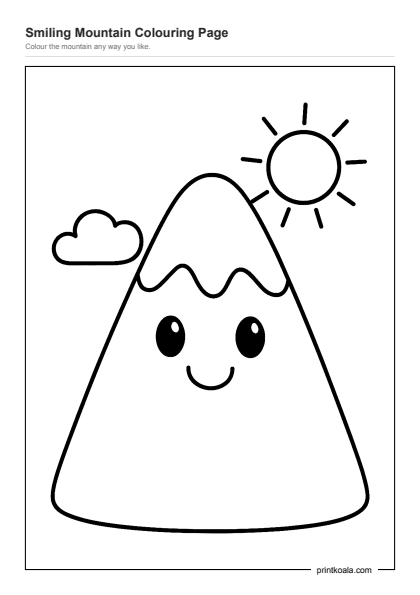
Smiling Mountain Coloring Page
Ages 2–46
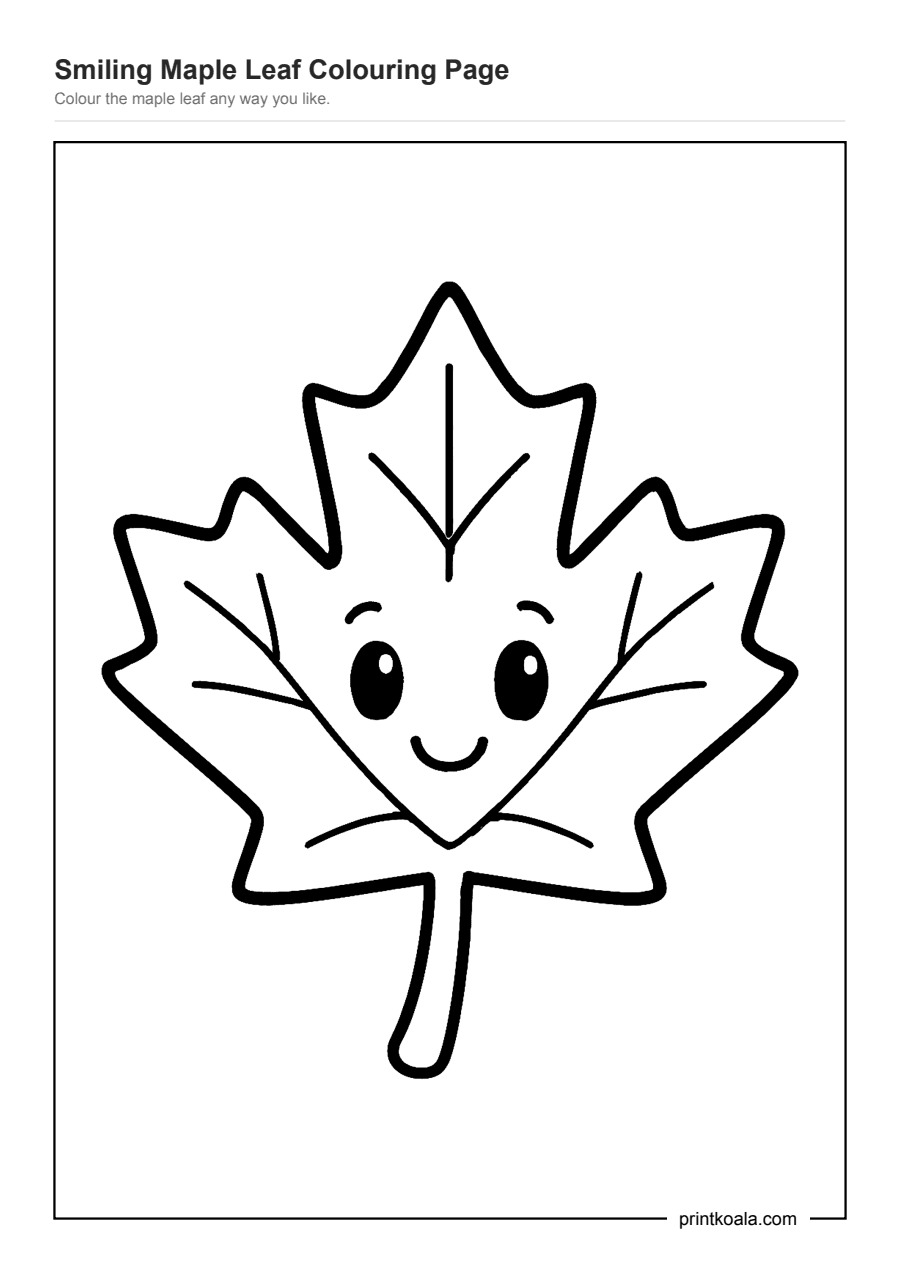
A single maple leaf with a happy face, five pointed lobes and branching veins, ready to fill in with autumn colors.
Free, no sign-up. Downloaded 9 times · A4 · Print at 100% scale
One maple leaf fills the page, its five points reaching up and out the way a real leaf spreads its lobes. In the middle sits a simple face: two round eyes with a white highlight dot, two curved eyebrows and a small smiling mouth. A thick central vein runs down from the top point and splits into branches that travel out toward each lobe, and a short curved stem hangs off the bottom.
The lobes themselves are big and open, so a child can color most of the leaf in a few broad strokes without worrying about the crayon slipping outside a thin line. The veins and the face are where the page asks for more care, since those spaces are narrower and closer together. It is a good page for talking about how many points the leaf has, or what color real maple leaves turn in autumn, while your child works out whether the face gets the same color as the leaf or something different.
There is only one shape on the page and no background clutter, so it prints quickly and does not eat much ink. It suits a child who is still building control with a crayon, since the outer lobes forgive a wobbly hand, while the vein lines give slightly older preschoolers something fiddlier to aim for. Either way it is a short, calm sheet rather than a big project.
Let your child start with the big outer lobes to build confidence, then move to the thinner veins and the small face last. If the veins feel too fiddly, skip them and leave the lobes as the main event.