🍎 Fruits
Know Your Fruits
Ages 3–535
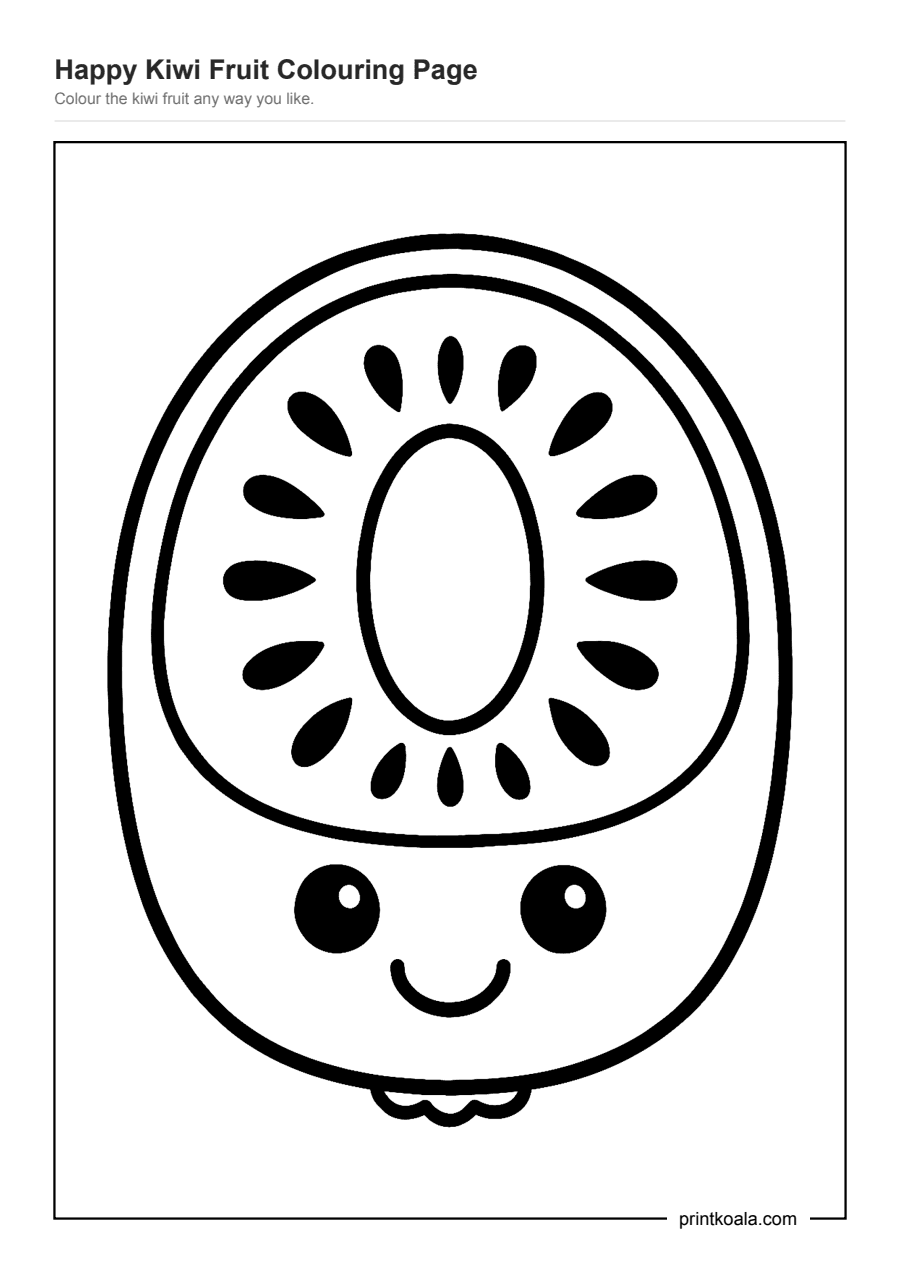
A smiling kiwi half shows off its ring of seeds and pale center, with a fuzzy whole-fruit outline below.
Free, no sign-up. Downloaded 10 times · A4 · Print at 100% scale
This kiwi is drawn whole, but the top of it is sliced open to show the inside. Inside the cut you can see a ring of little seeds circling a pale oval center, all sitting inside a thin skin border. Below the cut, the rest of the fruit is left plain, and a simple face has been added there: two round eyes with a tiny white shine, and a curved smiling mouth. A small scalloped bit at the very bottom stands in for the stem end.
The seeds are already inked in solid black, so a child does not need to fill in a whole ring of fiddly little shapes one by one. What is left to color is mostly generous and open: the wide body of the fruit, the skin ring around the seed pattern, and the pale core in the middle. That mix gives a child one easy big area to fill with a favorite green or brown, plus one smaller enclosed shape for the center, which is a nice size for a first go at staying inside a line. The face is a good excuse to talk about how the kiwi feels, or what it might be smiling about.
Because the hardest part of a real kiwi cross-section, the seeds, is already done for them, this sheet sits on the easier end of the fruit set. It suits younger colorers who are still building crayon control and want a page that looks finished quickly, though older toddlers will still enjoy picking two colors for the skin and the inside.
Start with the big skin area at the top, since it's the largest space, then move to the pale core in the middle. The seeds are already black, so there's no need to color those. Talk about how many seeds you can count together.