🍎 Fruits
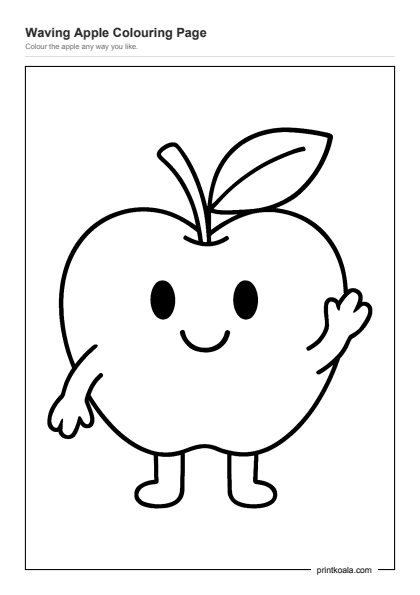
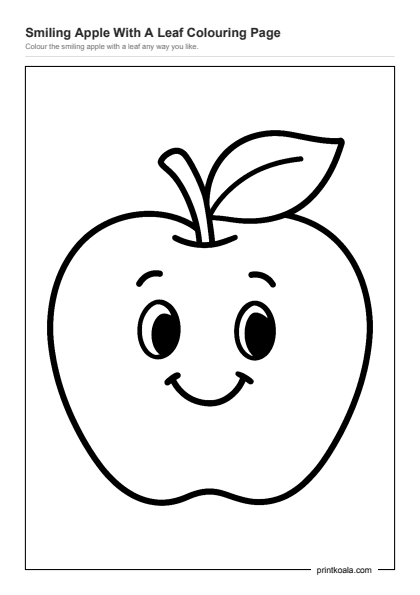
Smiling Apple with a Leaf Coloring Page
Ages 2–424
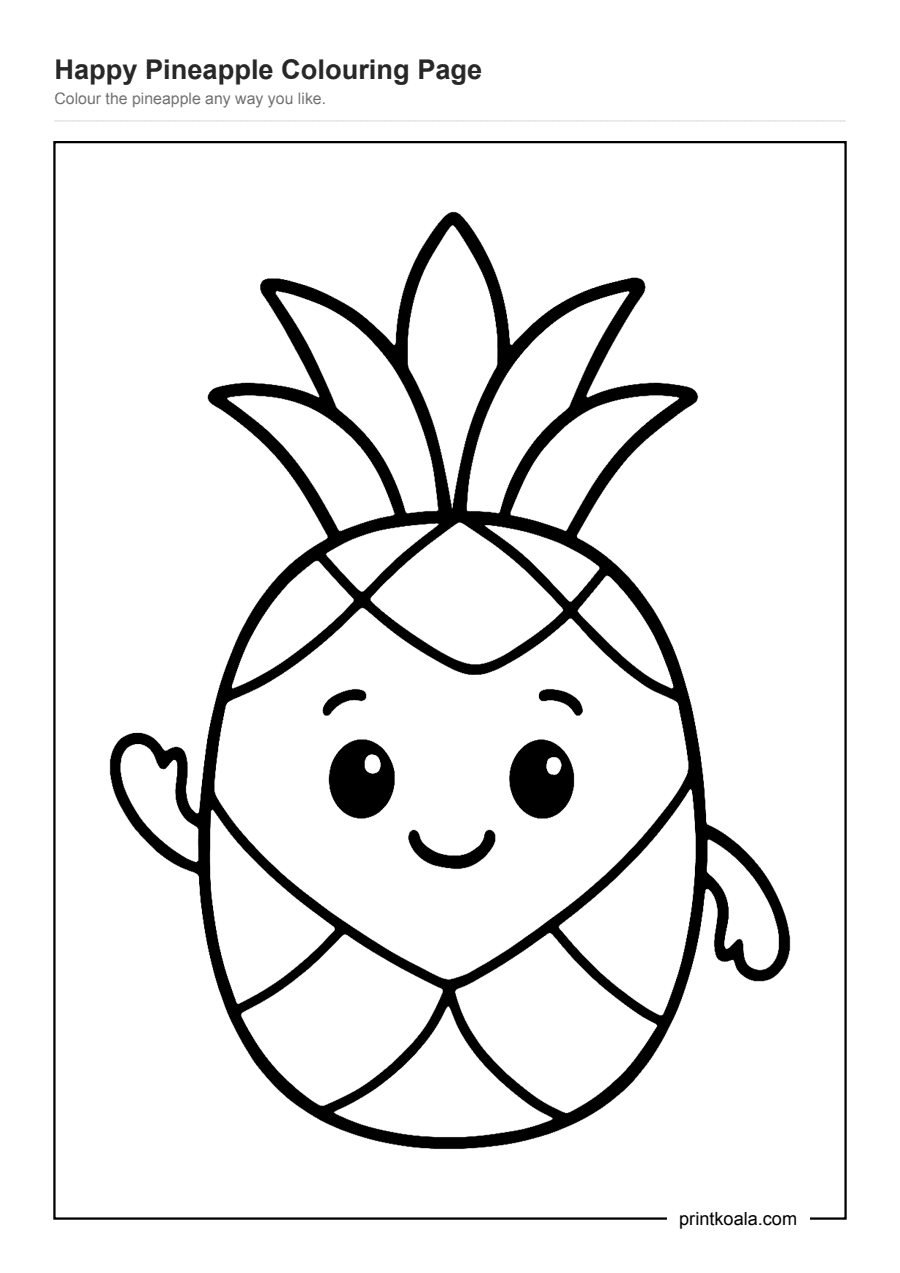
A smiling pineapple with one arm waving hello, its body marked into large diamond-shaped skin sections ready to color.
Free, no sign-up. Downloaded 15 times · A4 · Print at 100% scale
This pineapple has a face: two round eyes with a little highlight dot in each, a curved eyebrow above each one, and a closed, curved smile. One arm lifts up in a wave, fingers spread, while the other arm hangs down at its side. On top sits a crown of pointed leaves, tall in the middle and shorter towards the edges. Across the rounded body, curved lines cross over each other to mark out big diamond-shaped skin sections, stacked in a few rows from the crown down to the base.
The appeal here is size, not detail. Every section on the body is large enough for a young child to fill without straying over a line, and the leaves at the top are broad enough to manage the same way. There is no shading, no small print, no fiddly bits around the face, just open shapes a child can commit to one color at a time. It is an easy one to talk through while coloring: which arm is waving, how many leaves are poking up, whether the skin sections should all be the same yellow or a mix.
Compared to other fruit sheets in this set, this is on the simpler end. The crossing lines on the body ask for a bit more care than a plain outline would, since some sections narrow towards the edges, but nothing here needs real precision. It suits a child who is still building control over a crayon and wants to finish a whole page in one sitting.
Start with the big diamond sections in the middle of the body before moving to the narrower ones near the edges, so any early mistakes land where they show least. Try naming which arm is waving and which is resting.