🐸 Reptiles & Amphibians
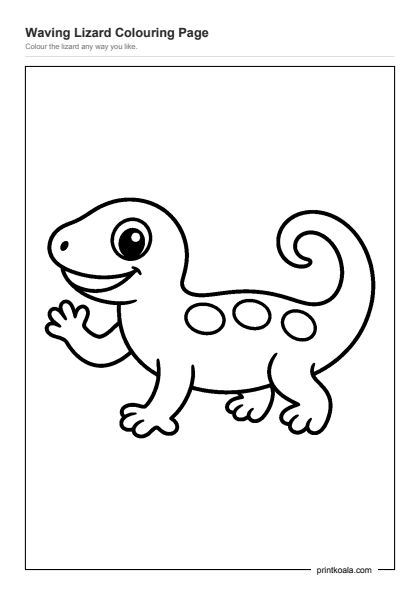
Waving Lizard Coloring Page
Ages 2–45
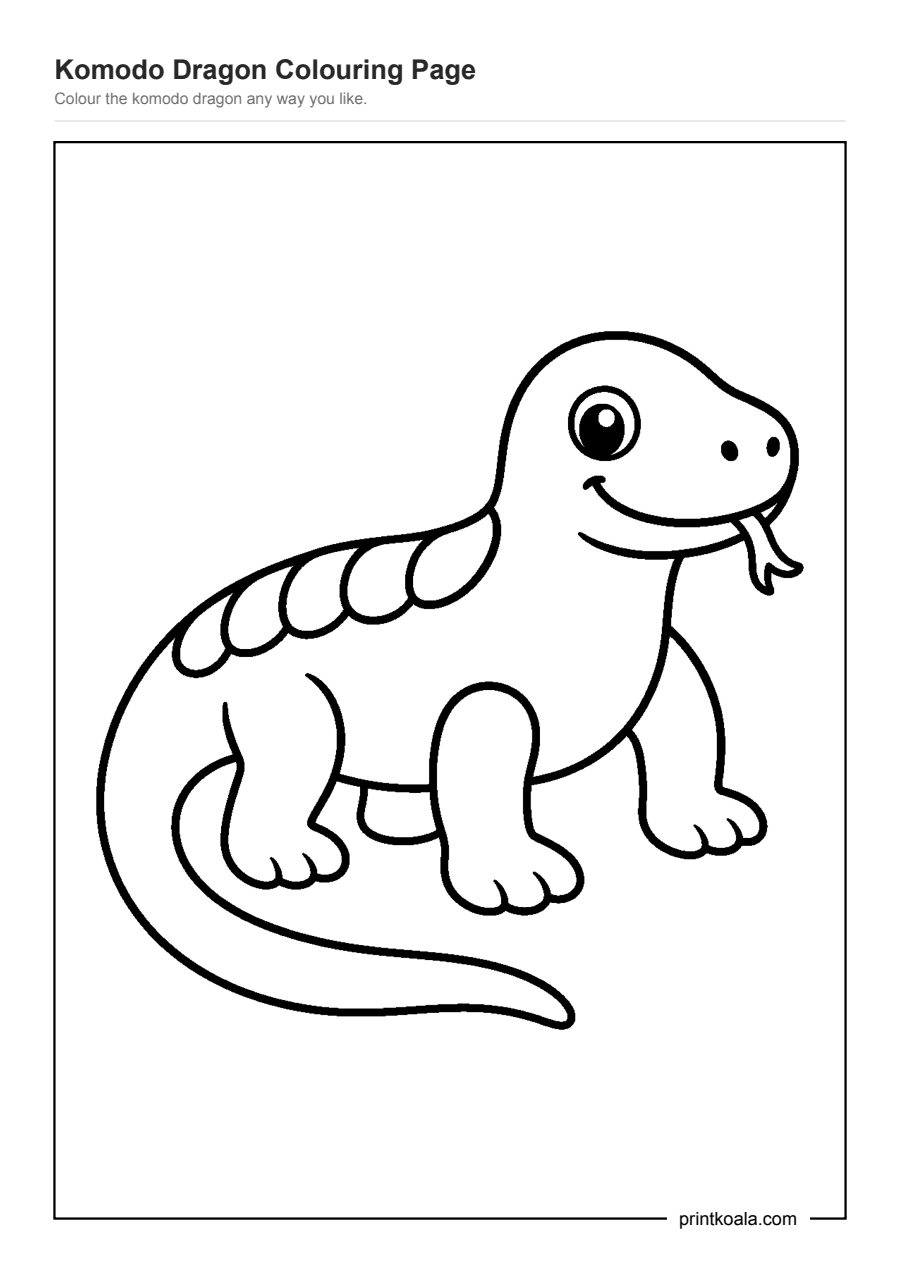
A big, smiling Komodo dragon shows its forked tongue and a row of five rounded back scales, its long tail curling right round toward its front paws.
Free, no sign-up. Downloaded 5 times · A4 · Print at 100% scale
This Komodo dragon stands on all four legs with its head turned out toward you, mouth open in a wide smile. A forked tongue pokes out one side of the mouth, and two small dots mark the nostrils above it. Running along its neck and back are five rounded, oversized scales, like a line of smooth bumps. The best part of the drawing is the tail: it sweeps out from the body, loops round in a wide curl near the back legs, then trails off into a long point that takes up most of the lower half of the page. There is no background, just the dragon filling the sheet.
The page is built from a few big, friendly shapes. The body, the tail and the humped scales are all large enough to color in with fast, loose strokes, which suits a child who is still working on staying inside the lines. The eye, the nostrils and the toes on each of the four paws are smaller and will need a steadier hand, so the page naturally moves a child from easy coloring to slightly trickier bits without being asked to do anything fiddly. It is also a good page for pointing out details together: the forked tongue, the row of scales, the way the tail curls right around.
Compared with other reptile sheets in this set, this one is on the simpler side. The thick outlines and open spaces make it forgiving for a first attempt, while the curled tail and small feet give slightly older preschoolers something to concentrate on. It works well for a toddler who just wants to fill a page with color and for a four or five year old who is ready to be a bit more careful with the smaller parts.
Start with the body and tail, the biggest shapes, so your child gets a quick win before moving to the fiddlier bits. Save the eye, nostrils and toes for when their hand is warmed up, and ask them to spot the forked tongue before they color it.