🐙 Ocean & Sea Creatures
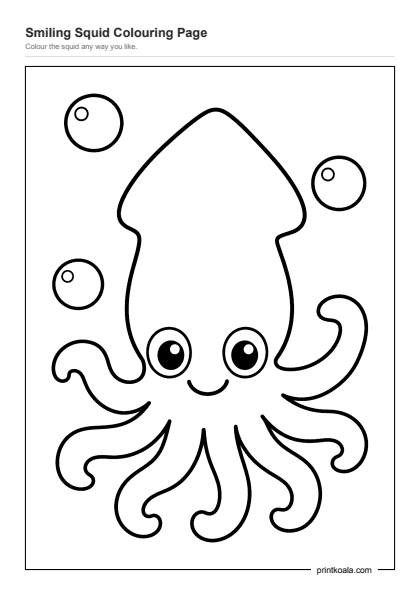
Smiling Squid Coloring Page
Ages 3–511
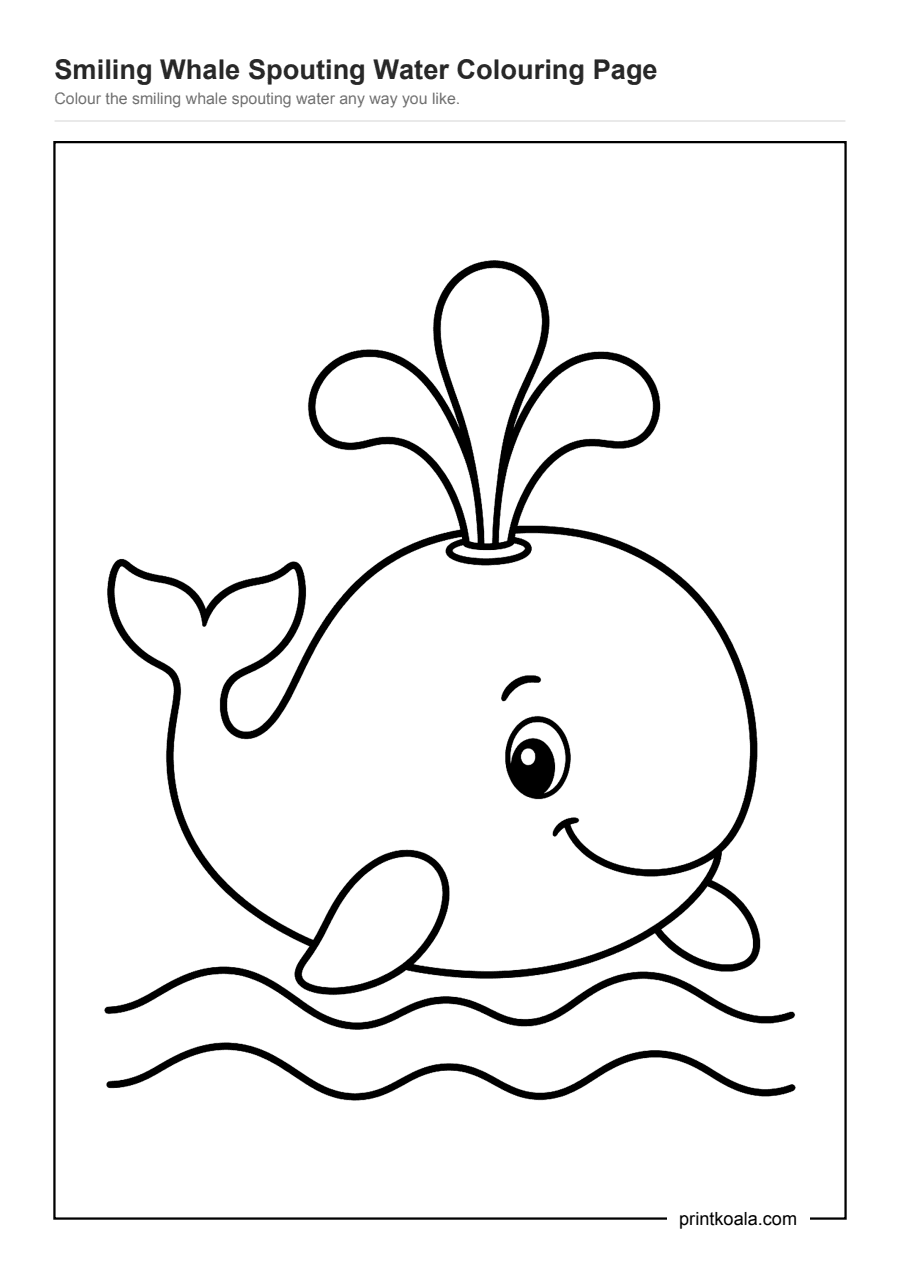
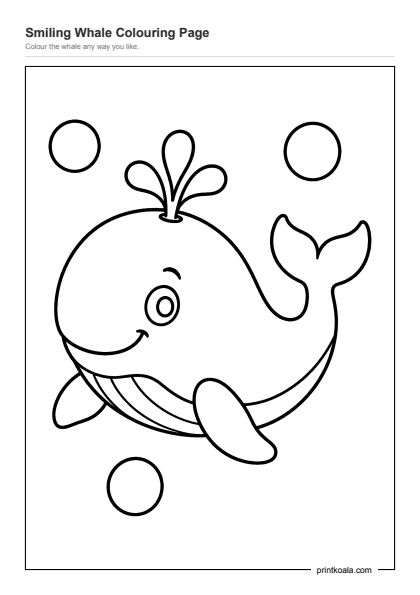
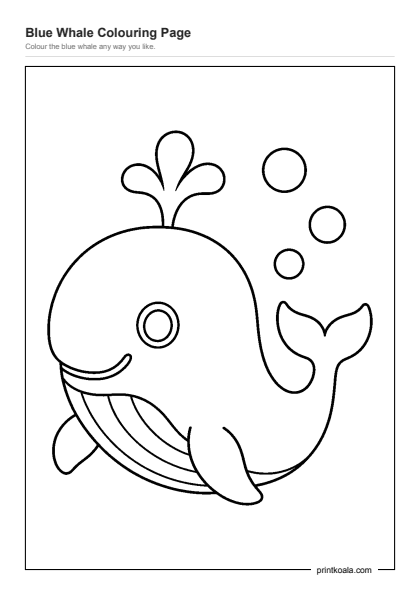
A round, smiling whale floats above two wavy sea lines, one big flipper down front and a three-petal water spout shooting up from its blowhole.
Free, no sign-up. Downloaded 6 times · A4 · Print at 100% scale
This whale takes up almost the whole page, drawn as one big rounded body with a single large eye, an arched eyebrow above it, and a curved closed-mouth smile. A wide paddle-shaped flipper reaches down at the front, a smaller fin peeks out near the tail on the right, and the tail itself curls upward on the left in two rounded lobes. From a small oval blowhole on top of its head, three teardrop-shaped bursts of water spray upward like a little fountain. Underneath the whale, two wavy lines stand in for the sea.
Most of this page is one enormous curved space, which is exactly what makes it good for a child who is still working out how to stay inside a line — the body alone could take up a whole coloring session in a single shade of blue or gray. The spout droplets, the eye, and the wavy water lines are smaller and more separate, so the same sheet also gives a bit of practice at coloring tighter shapes once the big body is done. It is an easy one to talk about too: how many drops of water are shooting up, which fin is bigger, where the tail is pointing.
The outlines are thick and the shapes are simple and rounded, with nothing fiddly or overlapping, so this suits younger colorers well, including children just getting started with a crayon. Older preschoolers can push themselves by giving the spout, the flippers, and the waves each a different color instead of just filling the whole whale in one go.
Let your child color the big whale body first since it is the easiest shape to fill, then move on to the smaller eye and spout droplets. If the wavy water lines wobble outside the edges, leave it — real waves are uneven too.