☂️ Everyday Objects
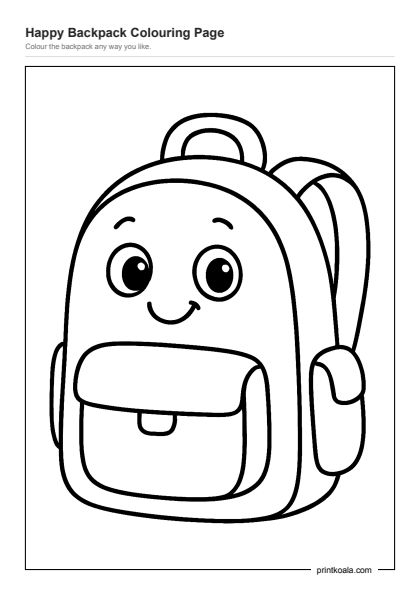
Happy Backpack Coloring Page
Ages 2–48
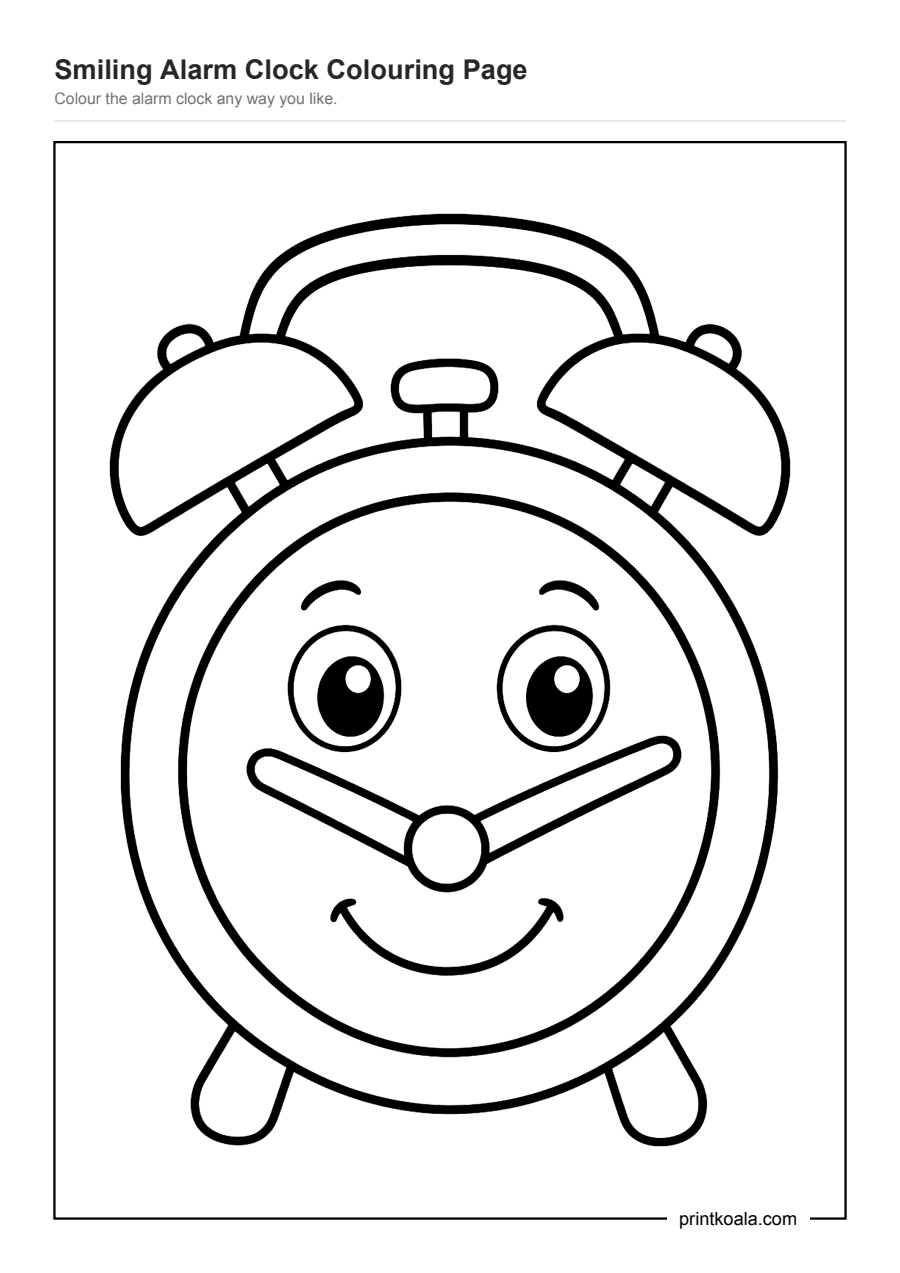
A round twin-bell alarm clock with a happy face, two clock hands and no numbers to worry about.
Free, no sign-up. Downloaded 3 times · A4 · Print at 100% scale
This alarm clock stands on two short feet with a carry handle arched between its two round bells, each topped with a tiny button. Its face fills almost the whole page: two big round eyes with raised eyebrows, a curved smiling mouth, and two plain clock hands meeting at a center dot, both pointing off to the left with no numerals printed on the dial. The clock face itself is drawn as two circles, one inside the other, giving a wide ring to color separately from the middle.
There is nothing fiddly here. The bells, the body, the two legs and the big open face are all large, closed shapes, so a child can color most of the page without their crayon straying outside the lines. The small parts, the bell buttons, the eyes, the pupils and the thin clock hands, are few enough that they read as a treat rather than a chore, and the double ring around the face is an easy spot to try two different colors side by side. It is also a natural page to talk over: which color will the bells be, does the clock look sleepy or wide awake, where do the hands seem to be pointing.
This is a gentle, forgiving sheet, better suited to a child who is still building confidence with a crayon than one hunting for a challenge. The large areas make it a good pick for three and four year olds, while the handful of smaller details give a five year old just enough to slow down for. It sits on the easy end of the Everyday Objects sheets, good for a first go at drawing a clock without any numbers to trip over.
Let your child start with the two bells and the big face, the easiest shapes, before tackling the eyes and clock hands. If the small center dot is tricky, a dot sticker or a single firm press of the crayon works just as well.