🦊 Forest & Woodland Animals
Deer with Little Antlers Coloring Page
Ages 2–59
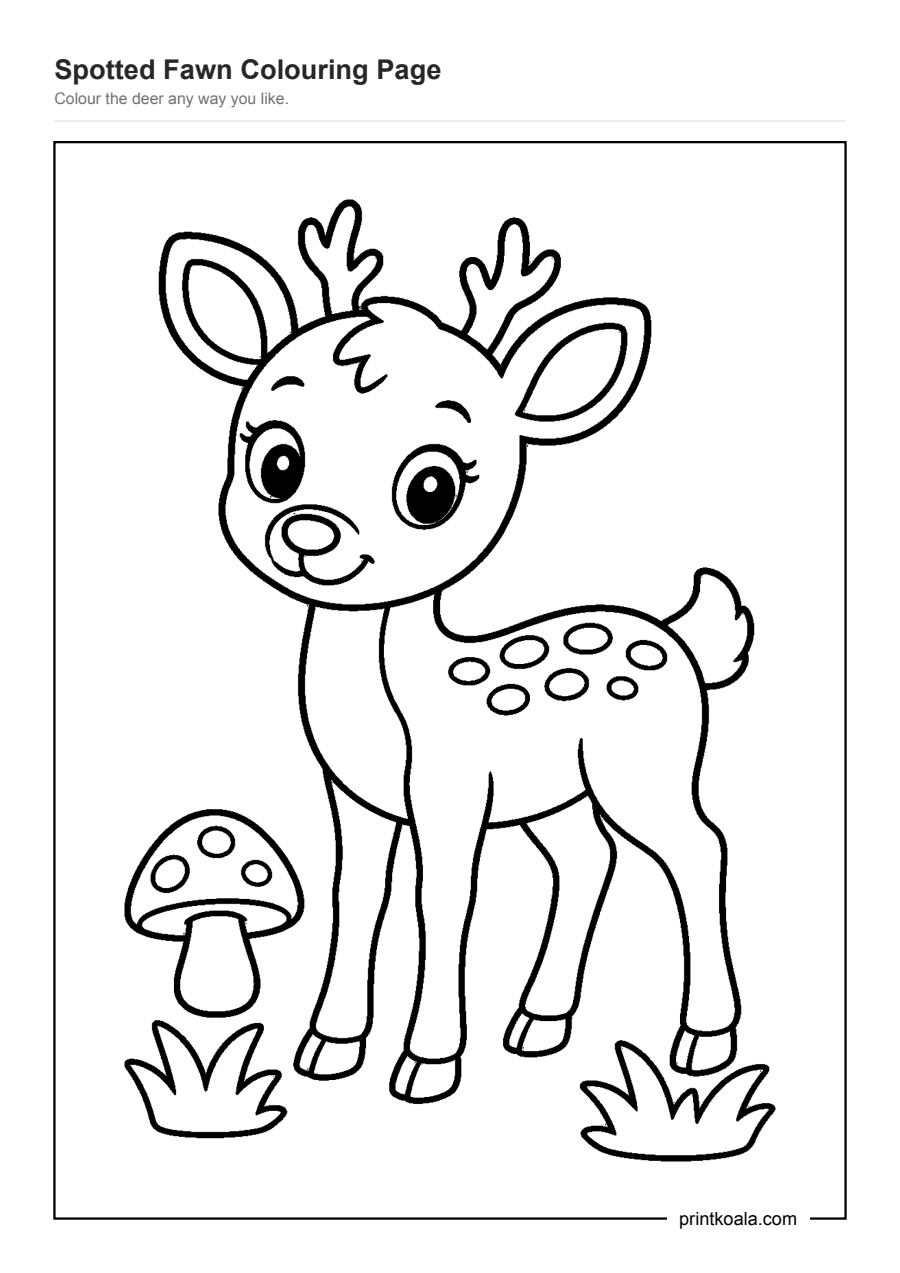
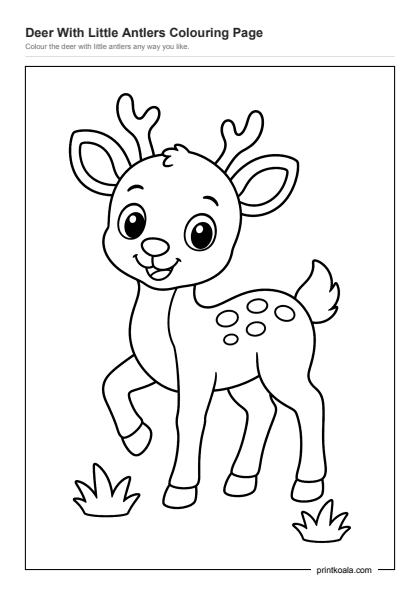
A young deer with small antlers and seven oval spots stands beside a spotted toadstool and two grass tufts.
Free, no sign-up. Downloaded 13 times · A4 · Print at 100% scale
This fawn stands facing forward with its head turned slightly to one side, one ear up and one ear out, and a pair of small branching antlers just starting to show above its head. Its face has big round eyes with eyelashes, soft brows, a rounded nose and a closed, gentle smile. Down its back and side are seven oval spots, evenly spaced, and a small tufted tail curls up near its rear leg. All four legs end in simple dark-tipped hooves. To the left of the deer stands a toadstool with three round spots on its cap, and two clumps of spiky grass sit at the bottom corners of the page.
The body, head and ears are big, open shapes, so a child can fill them in with one steady color without worrying about staying inside tight lines. The spots, the toadstool cap and the hooves are smaller enclosed areas that ask for a bit more care and a change of color, which is a natural point to talk about counting the spots or picking a color for the mushroom. The antlers have a few narrow branches, so they are the one spot where a wobbly line will show more than anywhere else on the page.
Most of this sheet is forgiving, which makes it a good one for a child who is still building control but wants something that looks finished quickly. The antlers and the smaller spots give slightly older preschoolers something to slow down for, so it works well across a wide age range and doesn't need to be finished in one sitting.
Let your child start with the body first, since it's the biggest area, then move to the smaller spots and antlers last. If the antler lines get tricky, skip them and come back once the rest is done, or color them a single flat color instead.