🦊 Forest & Woodland Animals
Hedgehog with an Apple Coloring Page
Ages 2–49
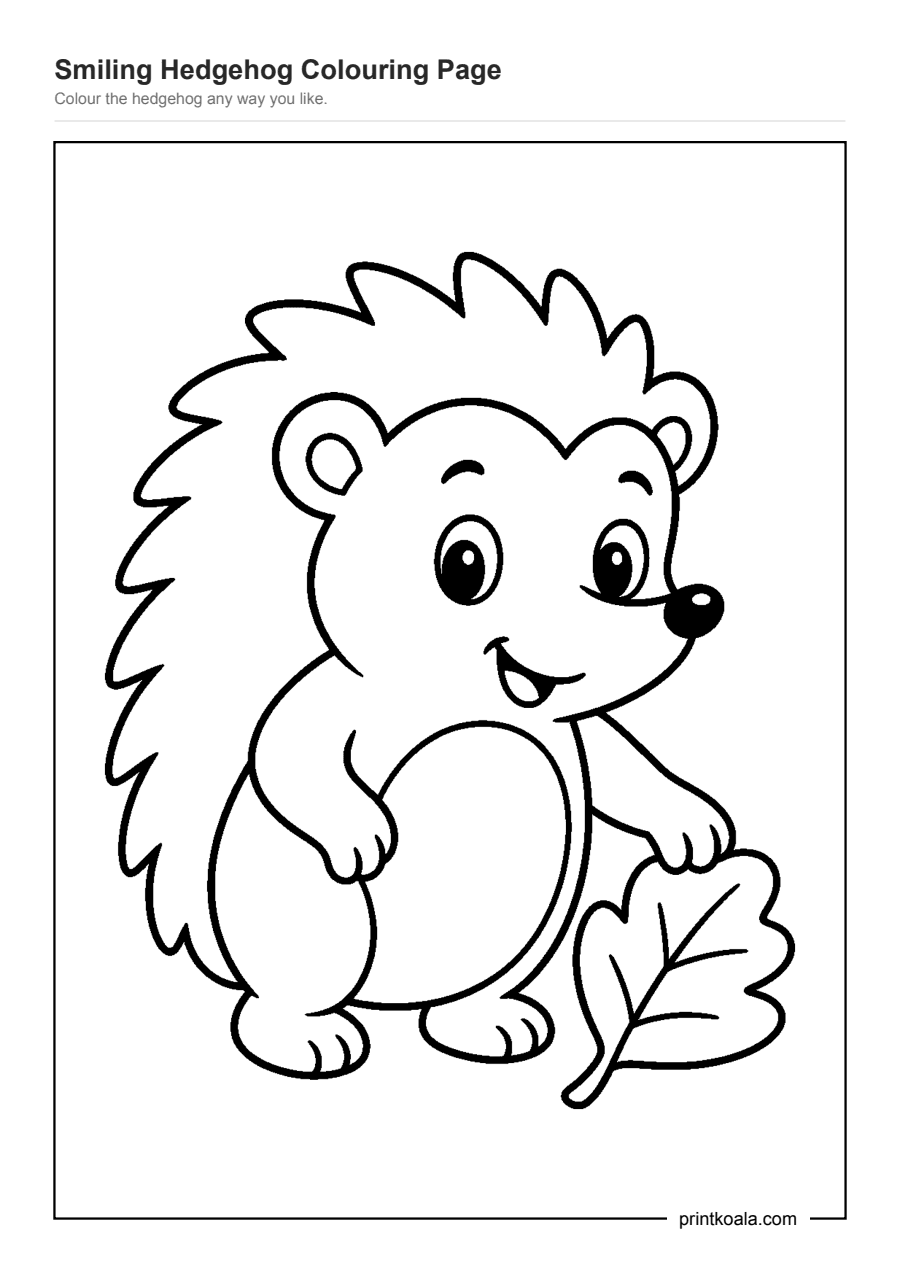
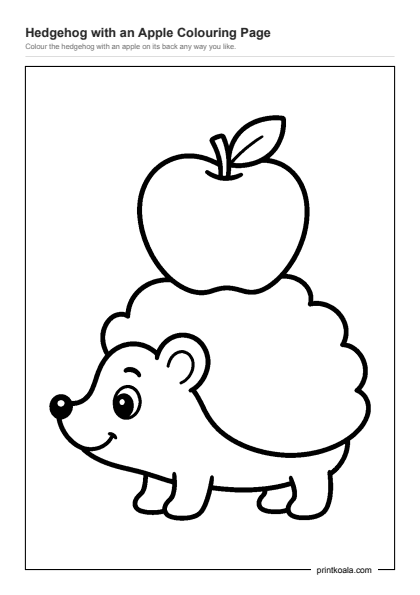
A round, smiling hedgehog stands on two feet with one paw resting on a big leaf beside it.
Free, no sign-up. Downloaded 5 times · A4 · Print at 100% scale
This hedgehog stands upright on its back feet, front paw propped on a large leaf next to it, the way a toddler might lean on a wall. Its face takes up most of the page: two big oval eyes with tiny highlight dots, a curved smiling mouth showing a bit of tongue, and a rounded black nose. The spines are drawn as a simple ring of jagged points around the head and back rather than dozens of fiddly lines, and the belly is marked off as one large separate oval from the rest of the body. Beside the hedgehog's paw sits a single oak-shaped leaf with a few vein lines down the middle.
Most of this page is made up of big, open shapes, the belly, the body, the spiky outline, so a child can color in broad strokes without much fear of going over a line. The eyes, nose and ear insides are small enclosed spaces that give a bit more of a challenge if you want to slow the page down, maybe using a darker color to pick them out from the rest. The leaf is a nice excuse to talk about brown and orange versus green, and whether hedgehogs live near trees like this one.
There is nothing fiddly here and no background to fill in, so it prints and colors quickly. It suits younger children who are still working on staying inside big shapes, or anyone who wants a page they can finish in one sitting rather than one that needs several goes.
Start with the belly and body, the biggest shapes, before moving to the smaller eyes and nose last. If a young child struggles with the spine points, let them treat the whole spiky outline as one color rather than counting each spike.