🦊 Forest & Woodland Animals
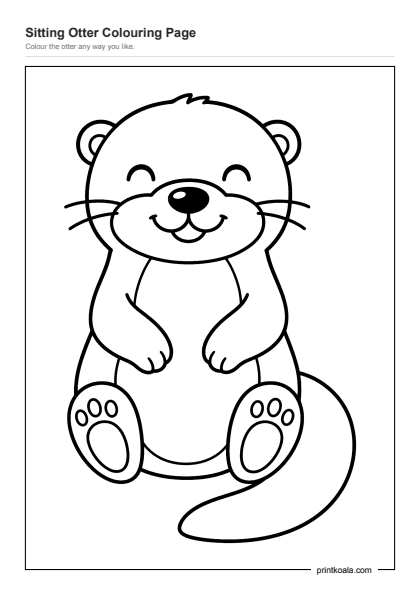
Sitting Otter Coloring Page
Ages 2–48
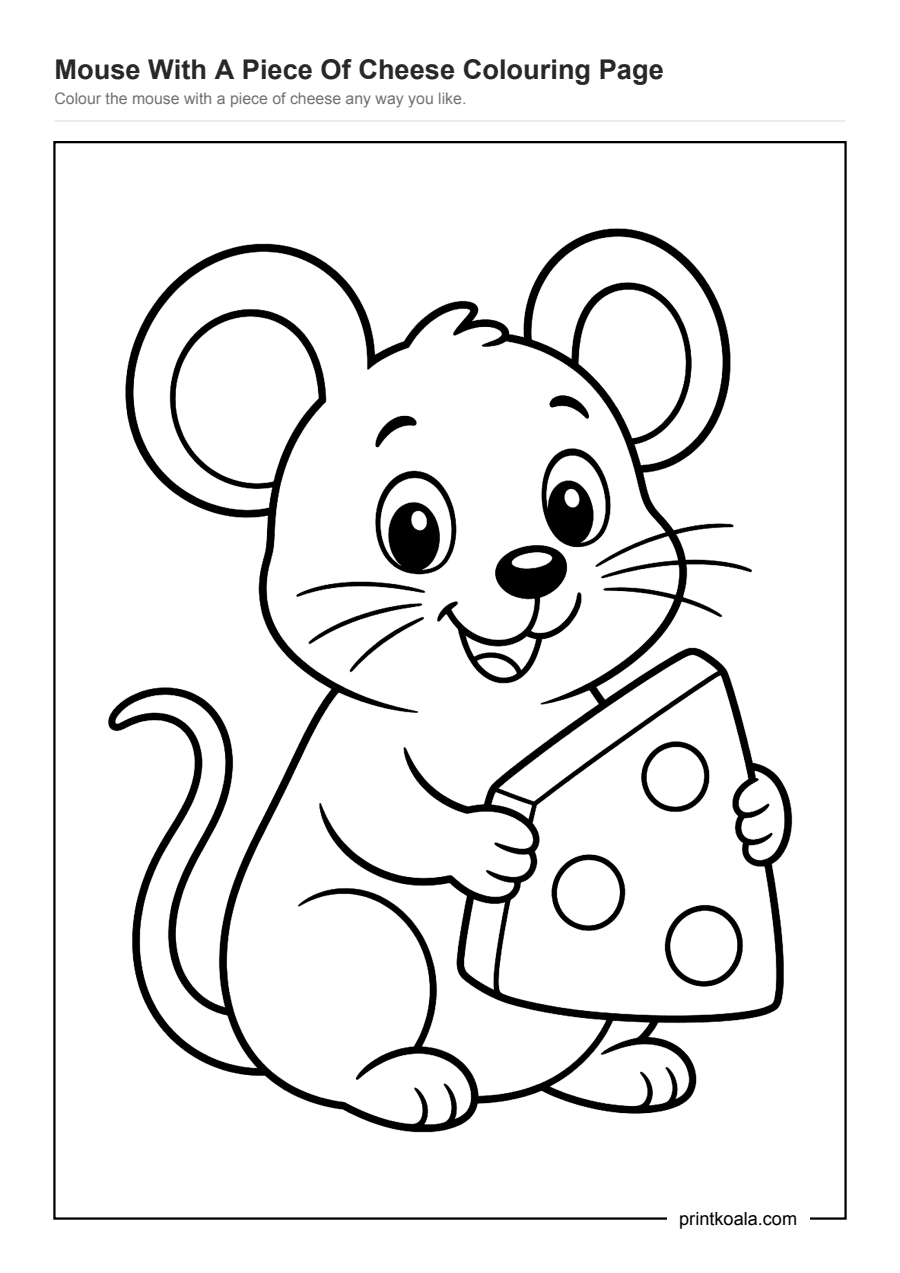
A round, sitting mouse hugs a big wedge of cheese with three holes, its tail curled beside it on the ground.
Free, no sign-up. Downloaded 14 times · A4 · Print at 100% scale
This mouse sits up on its haunches, both front paws wrapped around a large triangular wedge of cheese that is almost as big as its own body. Its mouth is open in a smile with two little teeth showing, and long whiskers spread out from both cheeks. The ears are two big rounded loops, each with a smaller ring drawn inside, and the tail curls in a loose S-shape on the ground to the left of the body. The cheese wedge carries three round holes of different sizes, and the mouse's small feet with simple toe lines poke out at the bottom. There is no background, just the mouse and its cheese filling the page.
The body, the ears, and the cheese wedge are all big, open spaces, so a child can color most of the page in broad strokes without needing to stay inside a tight line. The three cheese holes and the inner ear loops are the only small enclosed bits, which makes a natural stopping point for talking about which color goes where, maybe yellow for the cheese and gray or brown for the mouse. The open mouth and curled tail also give something to chat about while coloring, like what the mouse is about to eat.
This is a straightforward sheet with nothing fiddly in it, so it suits a child who is still building confidence with a crayon or who wants a page they can finish without a parent stepping in to help. Older preschoolers who enjoy adding detail can use the cheese holes and ear loops to practice a bit more care, but nothing here demands it.
Start with the big cheese wedge and mouse body first, since those are the easiest areas to fill in confidently. Save the three cheese holes and the inner ear loops for last, and it is fine if color strays slightly outside them.