☂️ Everyday Objects
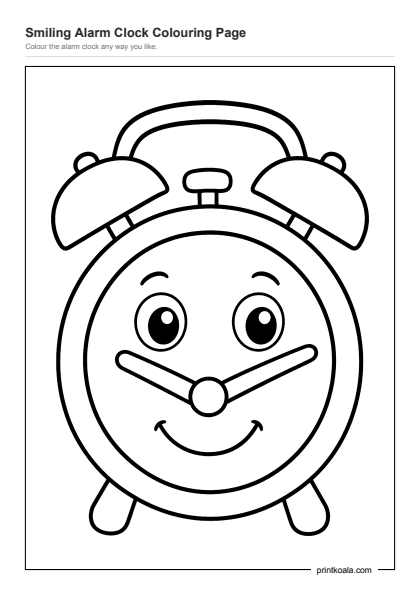
Smiling Alarm Clock Coloring Page
Ages 2–53
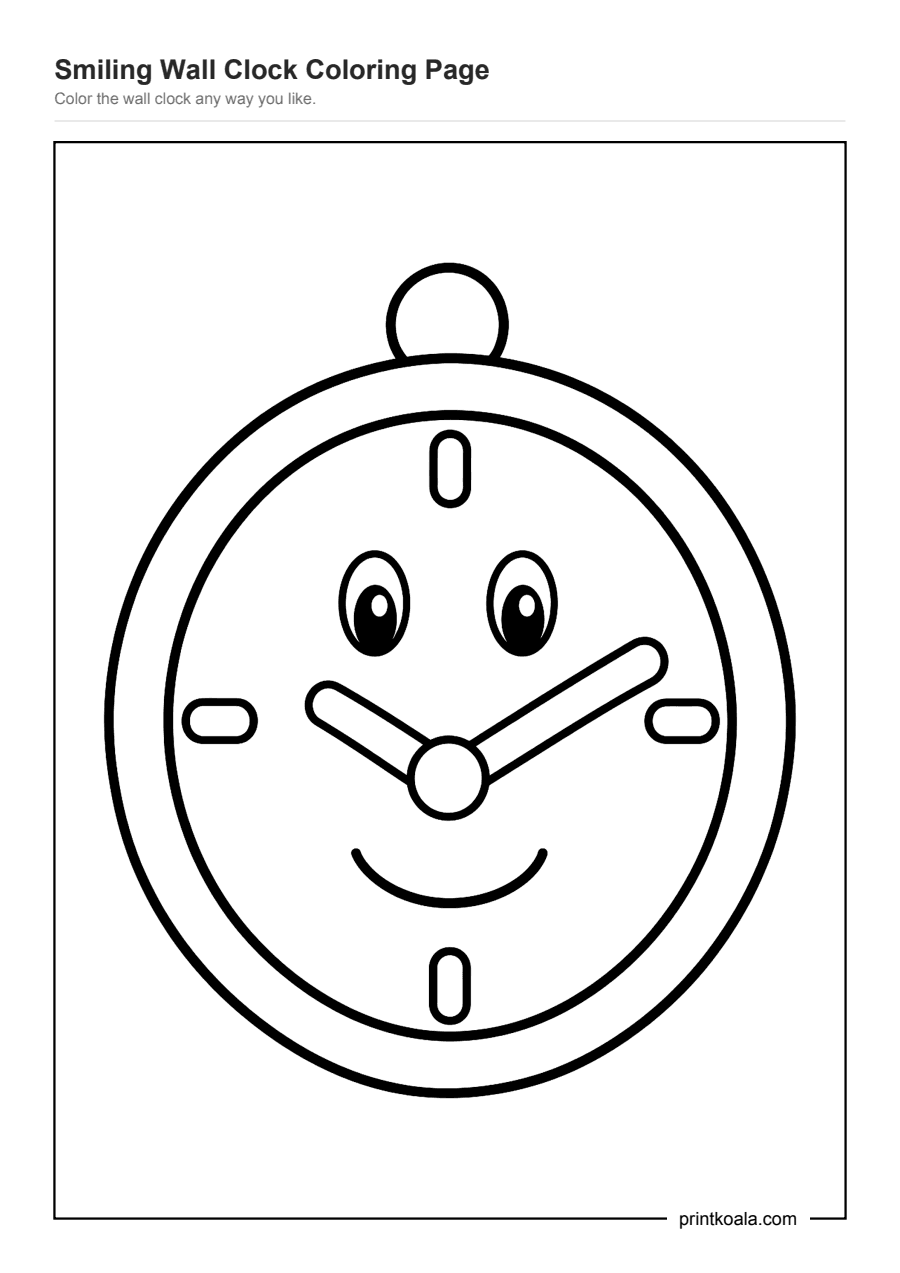
A cheerful round wall clock with a smiling face, four big hour markers and two broad hands, all in thick outlines for small hands.
Free, no sign-up. Downloaded 8 times · A4 · Print at 100% scale
This clock has a face of its own. Two oval eyes with round pupils sit above a curved smile, giving the whole clock a cheerful, cartoonish look rather than a strict, grown-up one. A small round knob sits on top like the button on an old alarm clock, and the body is bordered by a wide double ring that frames the face. Instead of numbers, there are just four plain rounded markers, one each at the top, bottom, left and right, and two hands, a shorter one and a longer one, meeting neatly at a small round hub in the middle.
The wide outer ring is the biggest space on the page, so it is the natural place to start, and it gives a child plenty of room to color in one steady sweep without worrying about staying inside tiny lines. The face and hands ask for more care, since the eyes, the smile and the four markers are all small enclosed shapes that reward slowing down. Because there are no numbers, this is also an easy moment to point at the hands and talk about which one is short and which is long, without getting into telling the time properly.
It is a gentle sheet overall: mostly large, rounded areas with just a handful of fiddly bits for contrast. That mix makes it a good fit for a child who is past scribbling but not yet confident with small details, and a fine warm-up before tackling a busier picture.
Start with the wide outer rim, then the face. Before coloring the hands, ask which one is short and which one is long, and where each is pointing.