🦋 Insects & Little Bugs
Butterfly on a Flower Coloring Page
Ages 2–47
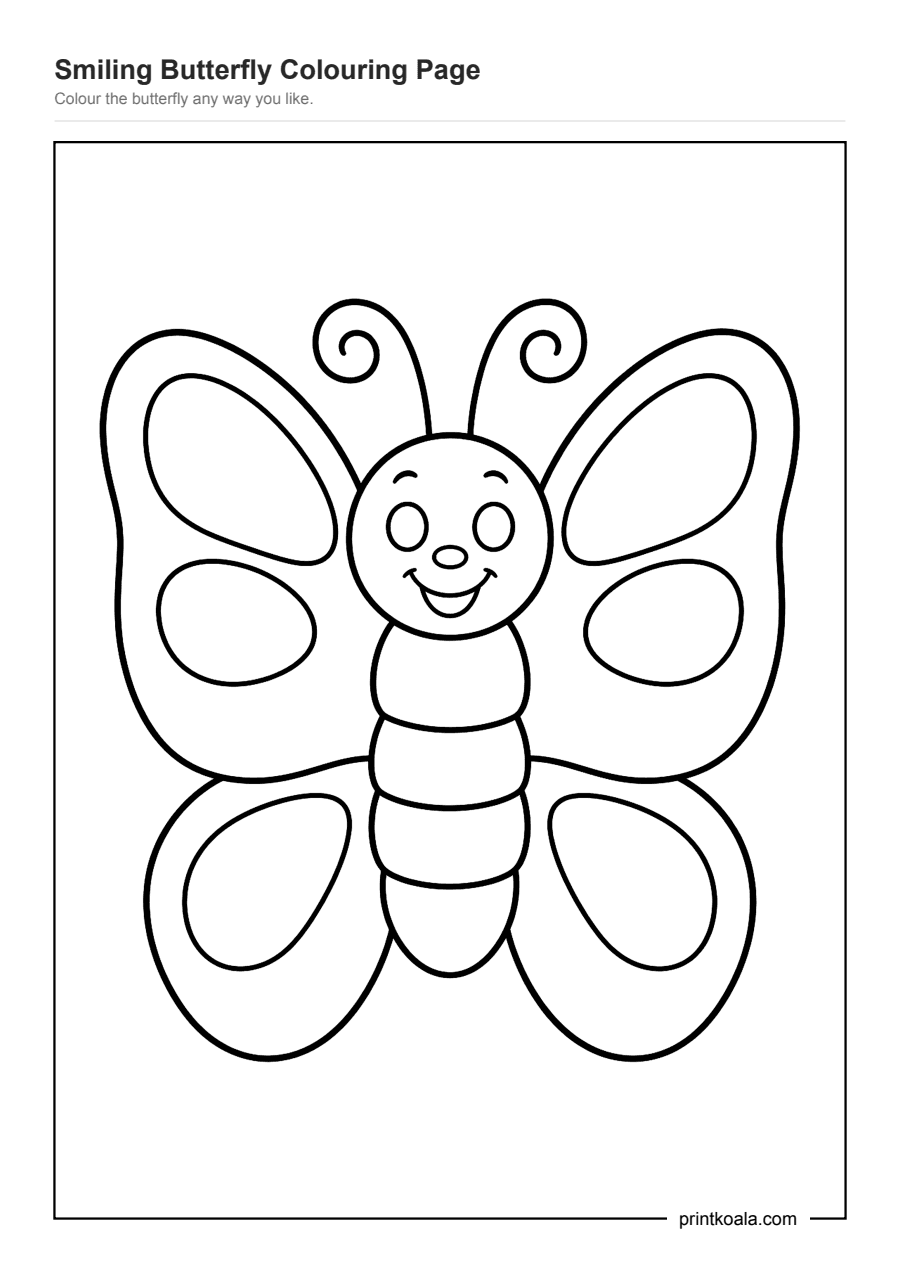
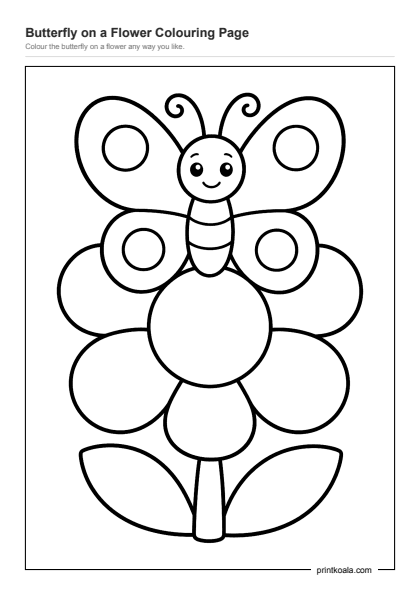
A front-on butterfly with a smiling face, curly antennae and four spread wings, each holding one or two large open patches to color.
Free, no sign-up. Downloaded 12 times · A4 · Print at 100% scale
This butterfly faces straight out at the child, wings spread flat and symmetrical on either side of a round, smiling head. Two curled antennae sit on top, and the face has big round eyes, a small oval nose and a wide open smile. The body is a stack of soft rounded segments running down the middle, like a row of connected beads, ending in a curved tail. Each of the four wings holds its own open shape or two inside the outline, so there are six good-sized patches waiting for color in total, plus the segmented body and the face.
What makes this one worth printing is the size of the spaces. The wing patches are large and rounded, with no sharp corners or thin gaps, so a preschooler can stay inside the lines without much fine control. Because the wings match left to right, a child can pick one color for the top wings and another for the bottom ones, or try to make both sides look the same, which is a nice thing to talk about while they work: "does this side match that side?" The face is small enough to need a bit more care with the crayon, which is a good change of pace after the bigger wing shapes.
This sits on the easy end of the shelf. The shapes are few, large and clearly separated, so it suits a two or three year old just getting used to holding a crayon inside a line, and it will not overwhelm a four year old either, though they may finish it quickly. It is not a page that will stretch an older child looking for detail.
Let your child start with the biggest wing patches first to build confidence, then move to the smaller shapes and finally the face last, since it needs the steadiest hand. Ask them if they want both sides to match.