🦋 Insects & Little Bugs
Ladybug on a Leaf Coloring Page
Ages 2–58
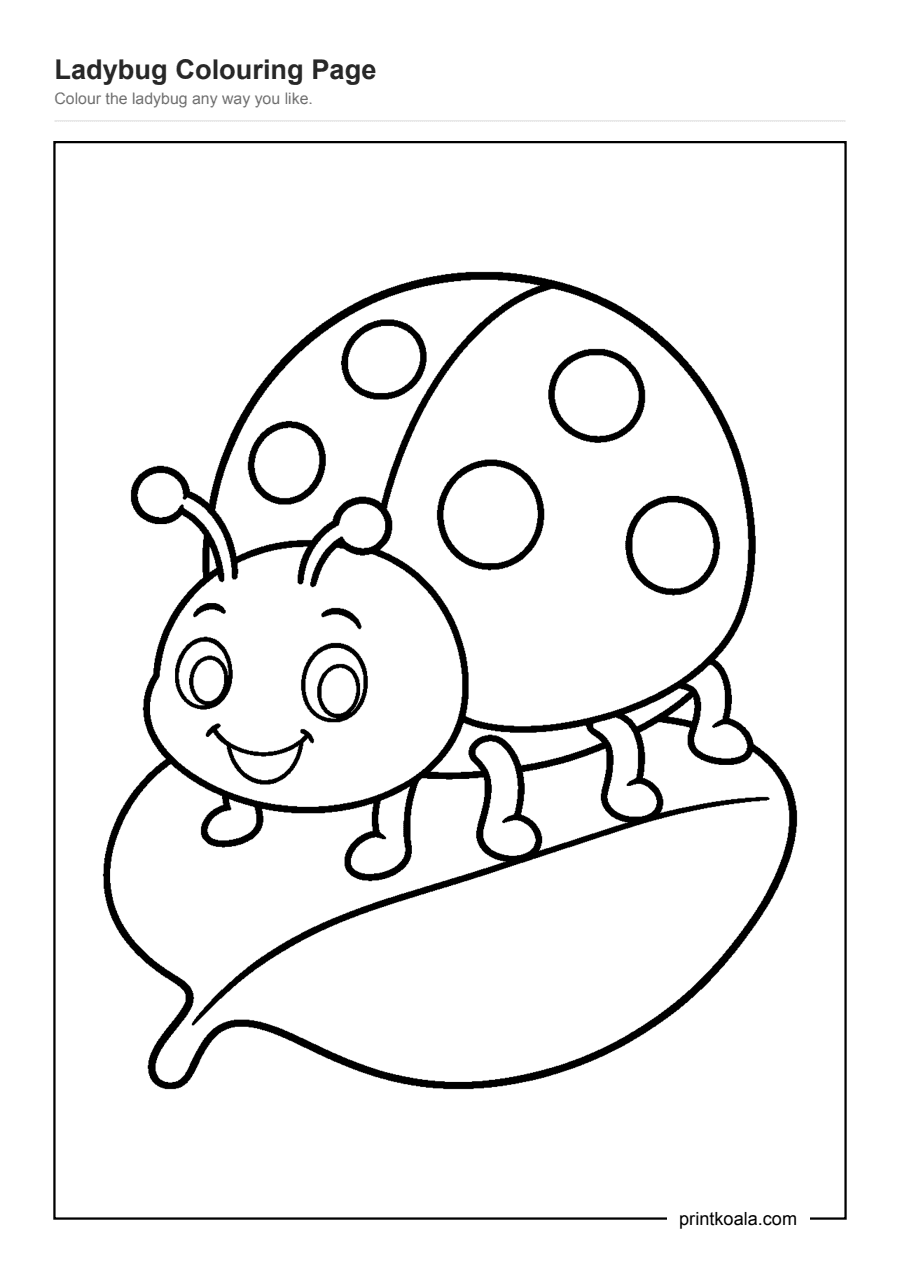
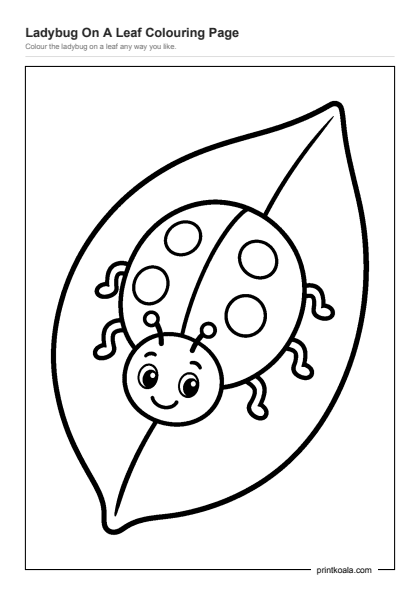
A smiling ladybug with five round spots and six curved legs rests on one big leaf, ready for coloring.
Free, no sign-up. Downloaded 11 times · A4 · Print at 100% scale
This ladybug takes up most of the page. It has a big round head with two large oval eyes, two curved eyebrow lines above them, a wide open smile, and two antennae ending in small round balls. Its shell is one large dome split down the middle into two wing covers, carrying five round spots in total, two on the left half and three on the right. Underneath, six curved legs with rounded feet stretch out and rest along the edge of a broad leaf, which has a single vein line running across it and a small curled stem at the bottom.
There is a lot for a young child to sink a crayon into here. The shell halves and the leaf are large, closed shapes that are hard to mess up, so they are a good place to build confidence before moving to trickier bits. The five spots are round and spaced well apart, which means a child can practice stopping at a curved edge without the spots running into each other. The face gives them something to talk about too: how many spots can you count, is the ladybug happy, where is it sitting.
Compared with other bug sheets in this set, this one is on the easier side. The outlines are thick, the shapes are simple, and there is no fine crosshatching or tiny background detail to fight with. It suits toddlers just getting comfortable holding a crayon as well as preschoolers who want to finish a whole picture without help, and it is a reasonable first choice if a child has not colored a ladybug before.
Start with the two big shell halves so your child gets an early win, then let them tackle the five spots one at a time. If a spot goes over the line, call it a pattern and move on rather than correcting it.