🌻 Flowers & Garden
Mushroom House Coloring Page
Ages 2–48
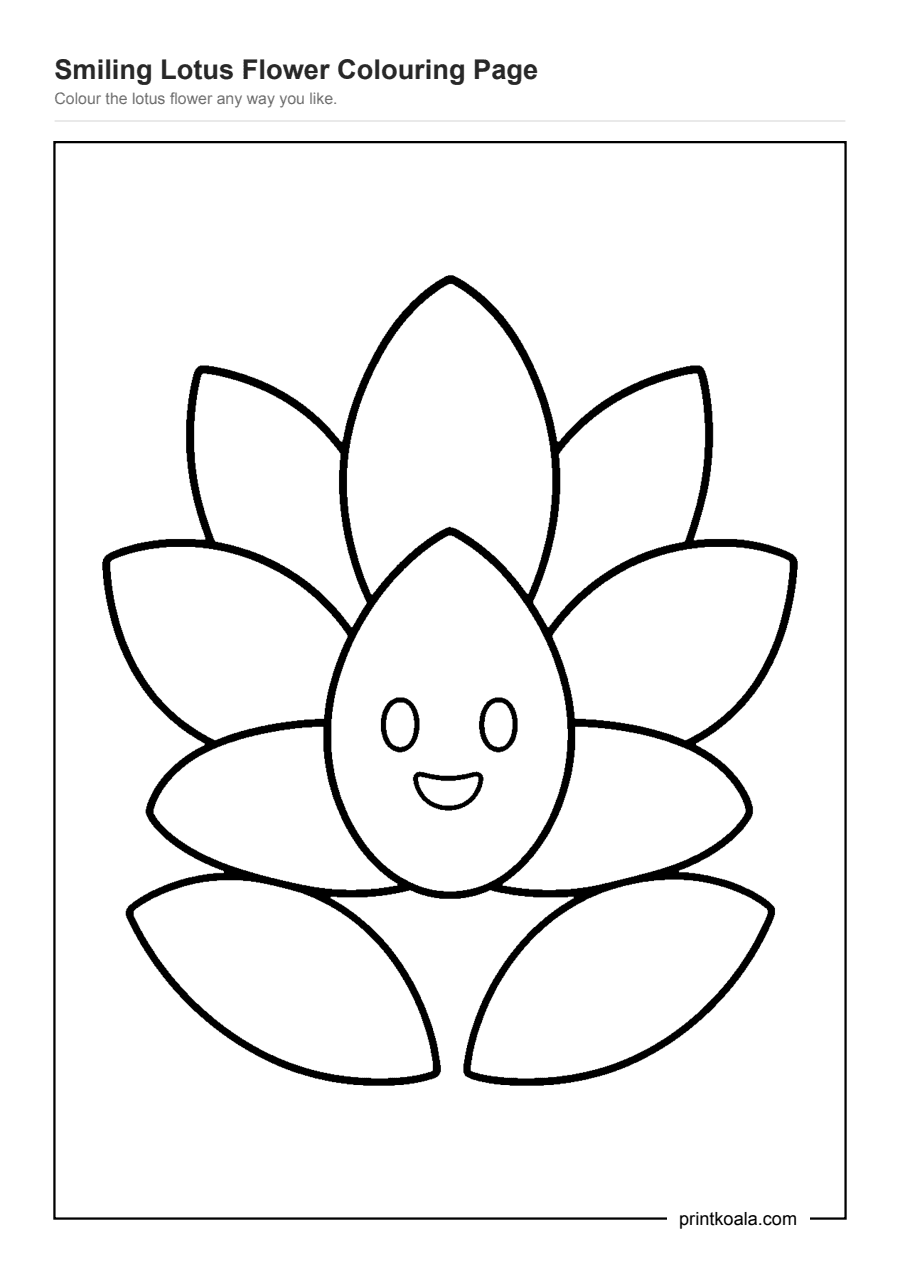
A lotus flower with a smiling face on its front petal, surrounded by seven plain petals fanned out in neat tiers.
Free, no sign-up. Downloaded 6 times · A4 · Print at 100% scale
This lotus is made of eight petals in total. The front petal is shaped like a teardrop and has a simple face inside it: two small oval eyes and a curved, closed-mouth smile. Behind that front petal, seven more plain petals fan outward in three tiers, a tall pointed one at the very top, two angled petals on each side below it, and two petals pointing down and outward at the base. There is no stem, no leaves and no pond, just the flower itself sitting on a plain white page.
The appeal here is in the shapes rather than the story. Every petal is a large, smoothly curved area with a clear outline, so a child can fill one in with a few big strokes and stay inside the line without much trouble. Because the petals come in matching pairs, this page is a nice excuse to talk about which ones are "the same" and whether they should be the same color or not, and the face gives one small spot where a child who wants to slow down can work more carefully with the tiny circles of the eyes.
There is nothing fiddly about this sheet, which is exactly the point. It suits toddlers just starting to hold a crayon as much as preschoolers who want something they can finish in one sitting, and it works well as a quick, low-pressure page rather than a big project.
Let your child start with the face, since the eyes and mouth are the fiddliest bits. After that the petals go quickly. Try naming left-right pairs and asking whether they should match or be different colors.