🌻 Flowers & Garden
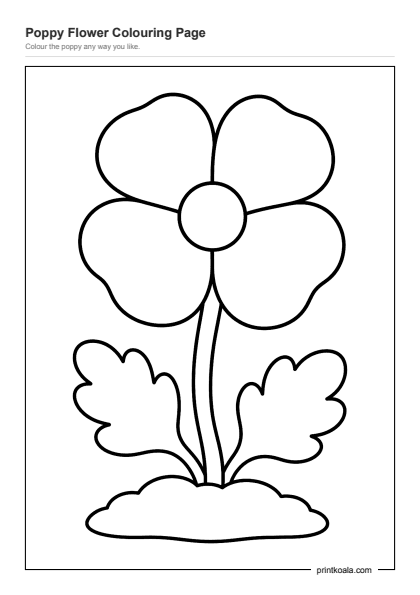
Poppy Flower Coloring Page
Ages 2–431
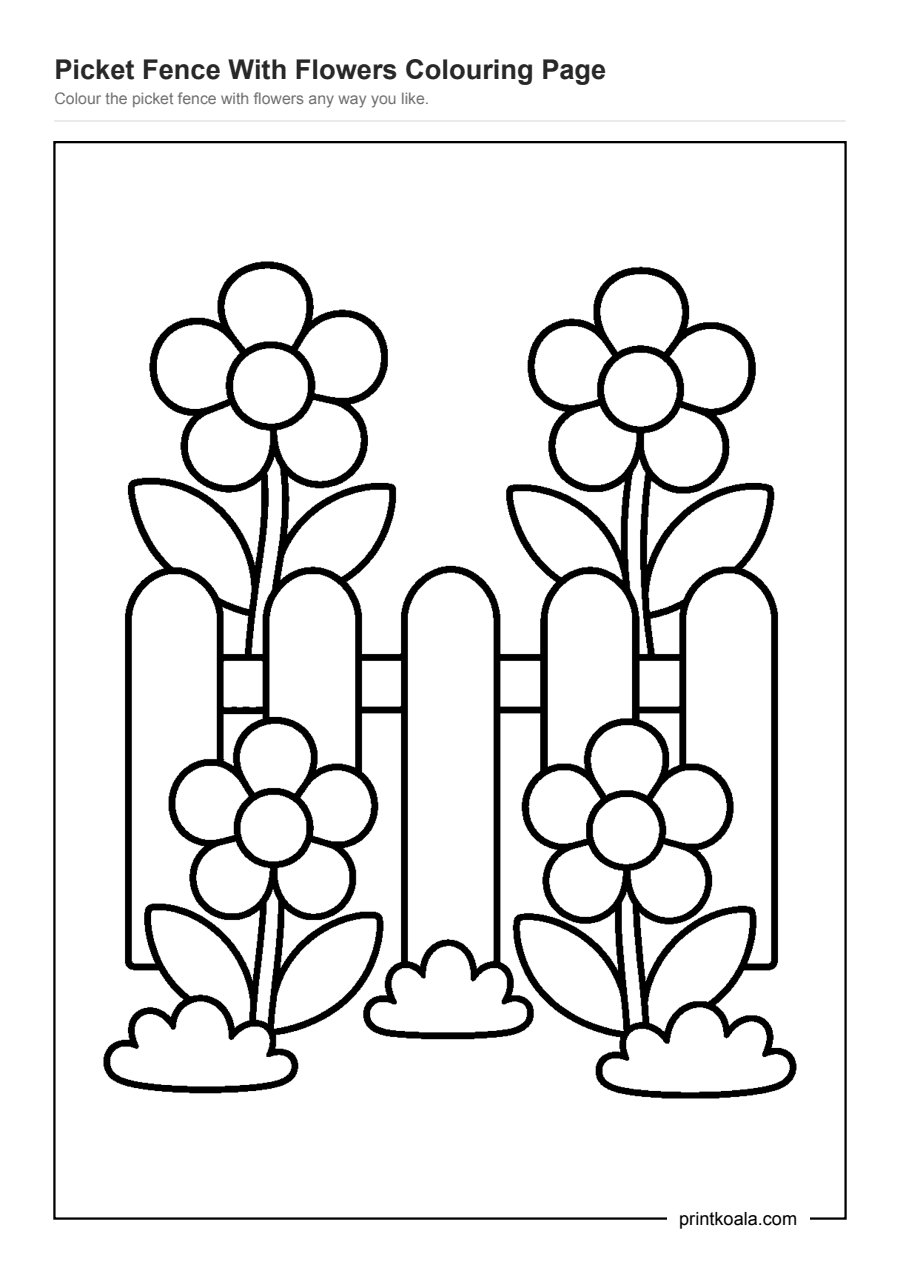
A row of rounded picket fence slats with four big six-petal flowers growing up on either side, and three bushy clumps at the base.
Free, no sign-up. Downloaded 8 times · A4 · Print at 100% scale
This page shows a plain picket fence, five rounded slats held together by two cross rails, standing in the middle of the picture. On either side of the fence, flowers grow tall: two large ones with their stems poking up above the top rail, and two shorter ones lower down in front of the fence. Every flower has the same shape, a round center circle surrounded by six fat petals, plus a pair of long pointed leaves on its stem. At the bottom of the page, three scalloped bushes sit like little hedges, one behind each pair of flower stems and one peeking out between the fence posts in the middle.
Nothing on this page is fiddly. The petals, the leaves and the fence slats are all big closed shapes, so a child can color inside the lines without needing a fine pencil grip. Because the four flowers are identical, this is a good page for deciding on a color plan and sticking to it, say yellow centers and red petals, and then repeating that choice four times. The overlaps, where a stem crosses a rail or a leaf sits behind a fence post, give just enough visual interest to talk about what's in front of what, without asking a small child to color anything narrow or awkward.
This is one of the easier sheets in the flower and garden set, better suited to a two or three year old still building control, or a four year old who wants to finish a whole page quickly and see it done. It doesn't teach counting or letters, it's simply a satisfying, low-pressure page to fill in with whatever colors are at hand.
Let your child pick two or three colors before starting, then color one whole flower first as a model to copy on the other three. If the thin stems are tricky, skip them and come back with a marker at the end.