🌻 Flowers & Garden
Flower in a Pot Coloring Page
Ages 2–49
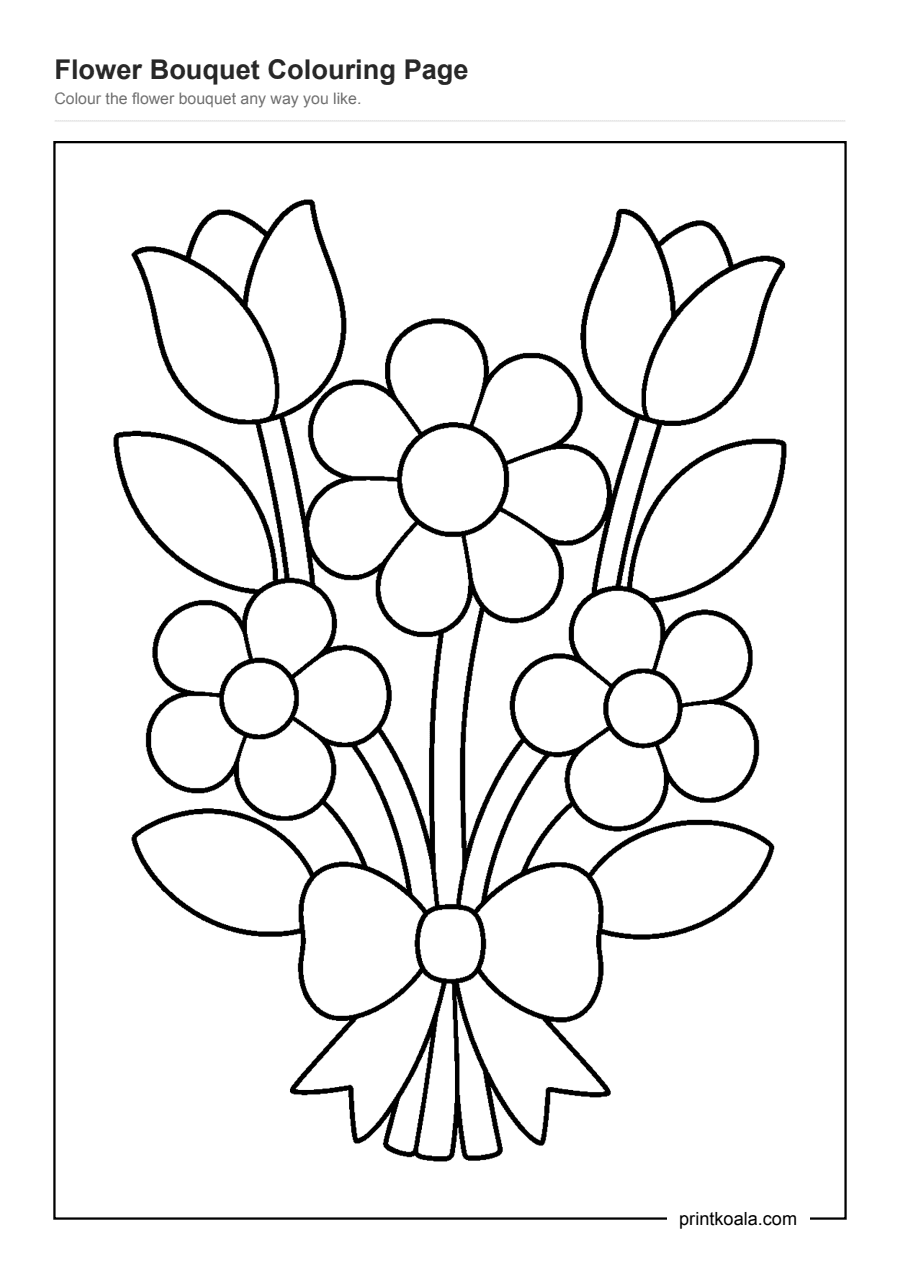
A hand-tied bouquet of five flowers, two tulips, a big daisy and two smaller ones, wrapped with a bow at the base of the stems.
Free, no sign-up. Downloaded 14 times · A4 · Print at 100% scale
This bouquet has five flowers in it: a tulip on the left, a tulip on the right, a large daisy-style flower with eight rounded petals in the middle, and two smaller five-petal flowers lower down on each side. Four pointed leaves sit behind the flowers, two up near the tulips and two down near the base. All the stems run down together and are tied with a bow, which sits right at the bottom with two loops and two ribbon tails.
There is a lot here that a young child can color without much trouble. The tulip cups, the leaves and the bow loops are all big, closed, single shapes, so a first go with crayons or felt tips fills them in fast and looks tidy. The two daisy-style flowers give the finer practice: eight petals on the big one, five each on the small ones, plus round centers to pick a different color for. That mix means a child can charge through the easy sections and then slow down for the flower heads, which is exactly where you want them pausing anyway. It is also a nice one for naming colors out loud, since nothing says the tulips and daisies have to match.
Against other flower sheets, this one sits in the middle. It is not as simple as a single giant bloom, because there are five flower heads and four leaves to keep track of, but none of the shapes are small or fiddly, so it does not demand careful hand control either. It suits three to five year olds well, younger ones with a grown-up naming which flower to do next, older ones working through it start to finish on their own.
Start with the tulips and leaves since they are the biggest, easiest shapes, then work down to the two smaller flowers, which have the fussiest petals. If your child loses interest partway, the bow at the bottom is a good, quick shape to finish on.