🐧 Arctic & Polar Animals
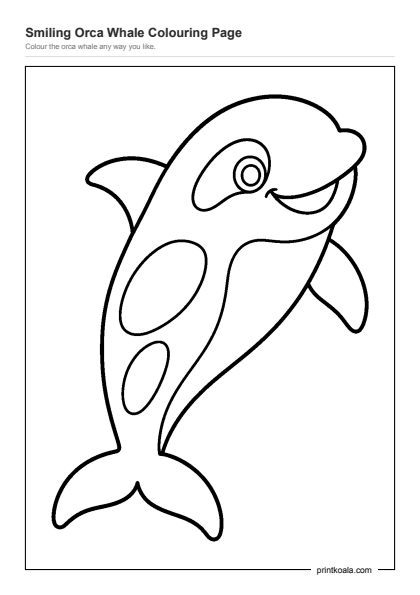
Smiling Orca Whale Coloring Page
Ages 2–510
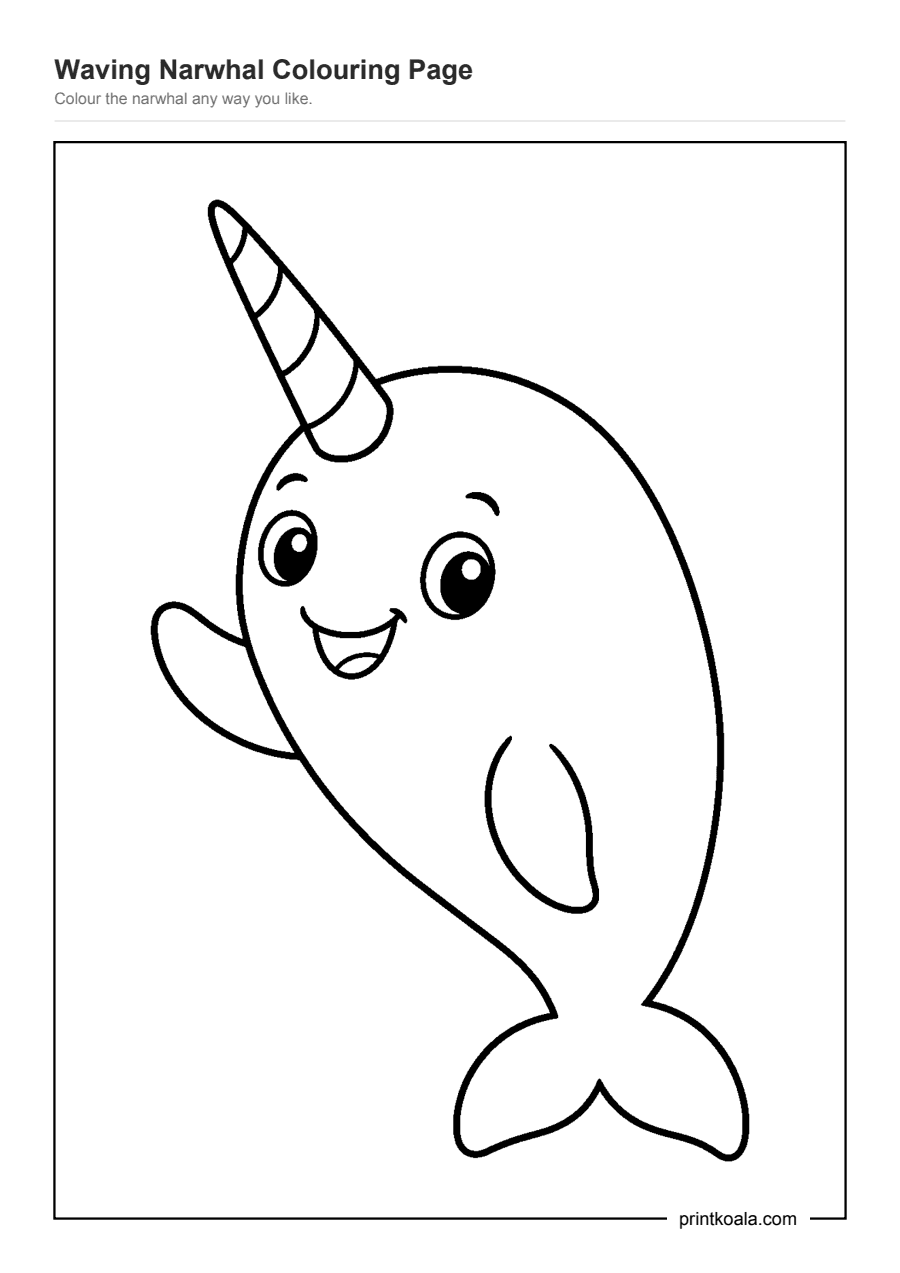
A round, smiling narwhal waves one flipper while its striped spiral tusk points up into the corner of the page.
Free, no sign-up. Downloaded 6 times · A4 · Print at 100% scale
This narwhal has a big rounded body that takes up most of the page, one flipper raised in a wave and the other resting lower down against its side. Its face has two large round eyes, curved eyebrows and an open, smiling mouth. The spiral tusk juts up and to the left, marked out in six or seven wide diagonal bands. At the bottom, a simple two-lobed tail curls off to one side. There is no background, sea or other characters to color, just the narwhal on its own.
The appeal here is the size of the shapes. The body, the raised flipper and the tail lobes are all broad, open spaces a young child can fill in with a few strokes of one crayon and not worry about staying inside a tiny line. The tusk is the one part that asks for a bit more care, since it is split into several narrow sections, and it is a natural place to talk about colors going one after another, or even to try a different shade in each band for a striped effect. The eyes are small and can simply be left black or colored over, whichever the child prefers.
Overall this sits on the easy side, closer to a first coloring sheet than a detailed one, thanks to those large open areas. The tusk stripes give it just enough of a challenge to hold the interest of a child who has outgrown the very simplest pages. It suits toddlers coloring for the first time and preschoolers who want to move faster than a page full of small details would allow.
Let your child start with the body, the biggest space, before moving to the tusk. If the tusk bands feel fiddly, it is fine to color them all one color, or skip outlining and just scribble across the whole tusk.