🐙 Ocean & Sea Creatures
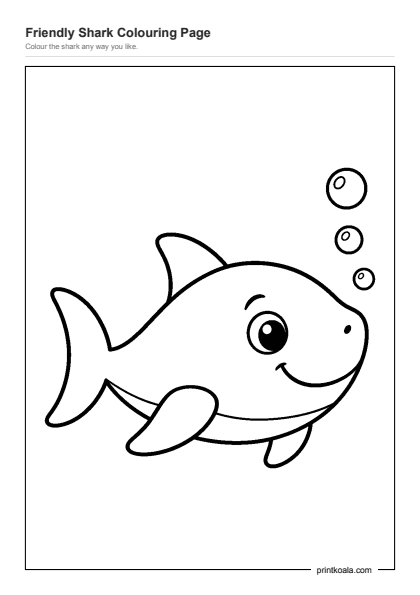
Friendly Shark Coloring Page
Ages 2–49
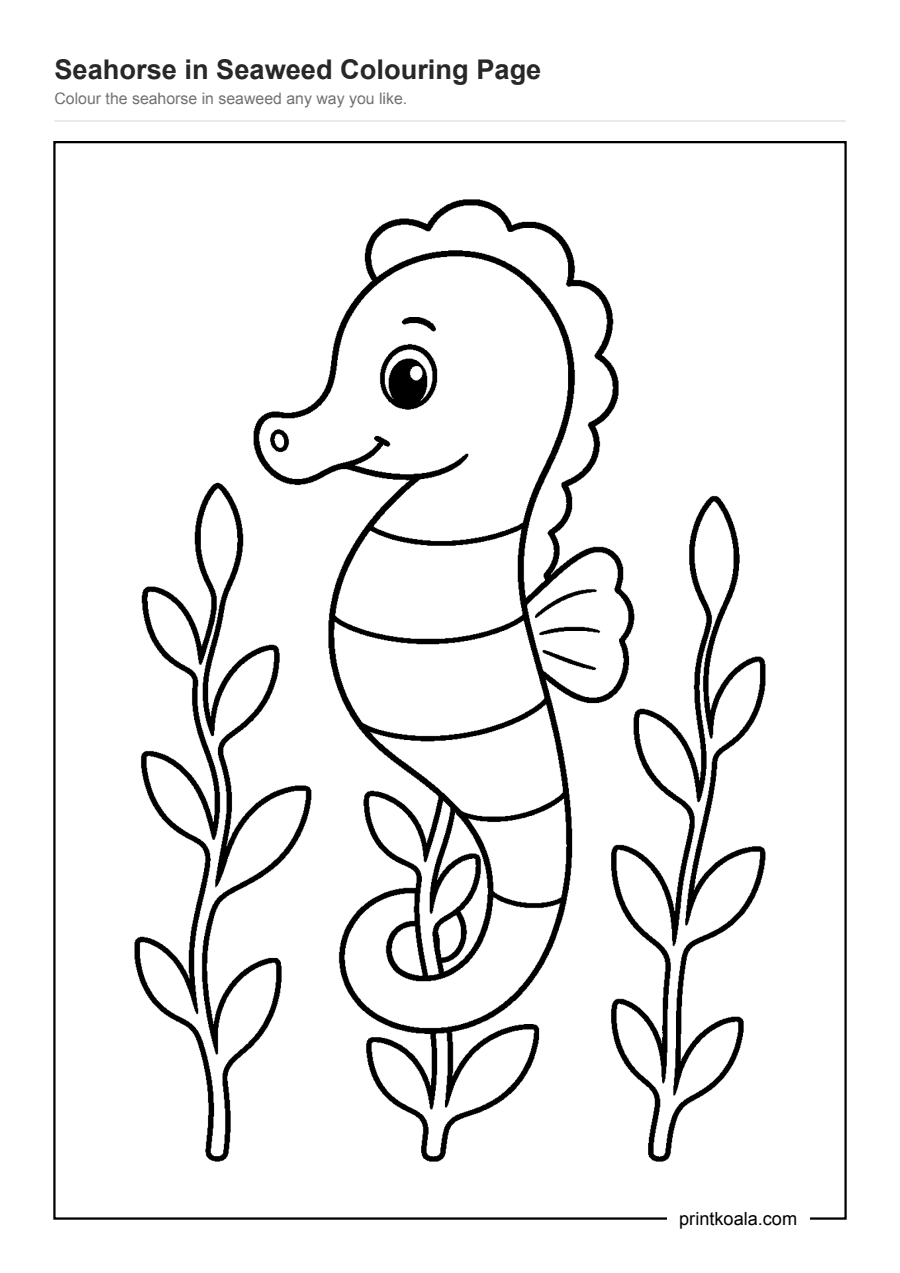
A curly-tailed seahorse with a spiky crown wraps its tail around a middle seaweed stalk, flanked by two more leafy stalks.
Free, no sign-up. Downloaded 13 times · A4 · Print at 100% scale
This seahorse faces left with a big round eye, a small tube snout and a jagged crown of spikes running down the back of its head. Its body is split into four wide horizontal bands, with one small ruffled fin poking out on the side. Down below, the tail curls into a tight spiral and wraps around the middle of three seaweed stalks. That center stalk stands between two more on either side, each one a straight stem lined with plain oval leaves, six or seven per stalk.
The body bands are the main draw here: broad, flat, and easy for a small hand to fill without straying over a line, which makes this a good one for practicing steady strokes rather than fighting fiddly shapes. The curled tail is the one part that asks for more care, since the spiral is narrow where it wraps the seaweed stem. The three seaweed stalks are all identical in shape, so a child can either keep them the same color for a calm, uniform picture or give each one something different and turn it into a small choice-making game. The seahorse's smiling face is simple enough to talk about while coloring — where its nose is, why its tail curls, how it might be hiding among the leaves.
Next to other ocean sheets in this set, this one sits on the easier side. There is no background clutter and nothing tiny to color except the fin and the tail spiral, so it suits a child who is just starting out with animal coloring pages or one who wants something they can finish without help. Older preschoolers who like more detail may find it goes by quickly, but as a first seahorse page, or a calm five-minute activity, it does the job well.
Start with the four body bands, since they are the biggest, easiest areas. Save the tail spiral for last, as it is the fiddliest part. If the spiral feels too small, it is fine to color it as one solid shape rather than following every curve.