🦁 Safari & Jungle Animals
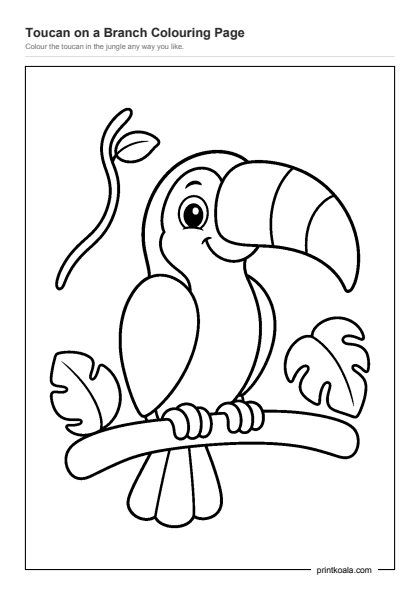
Toucan on a Branch Coloring Page
Ages 2–59
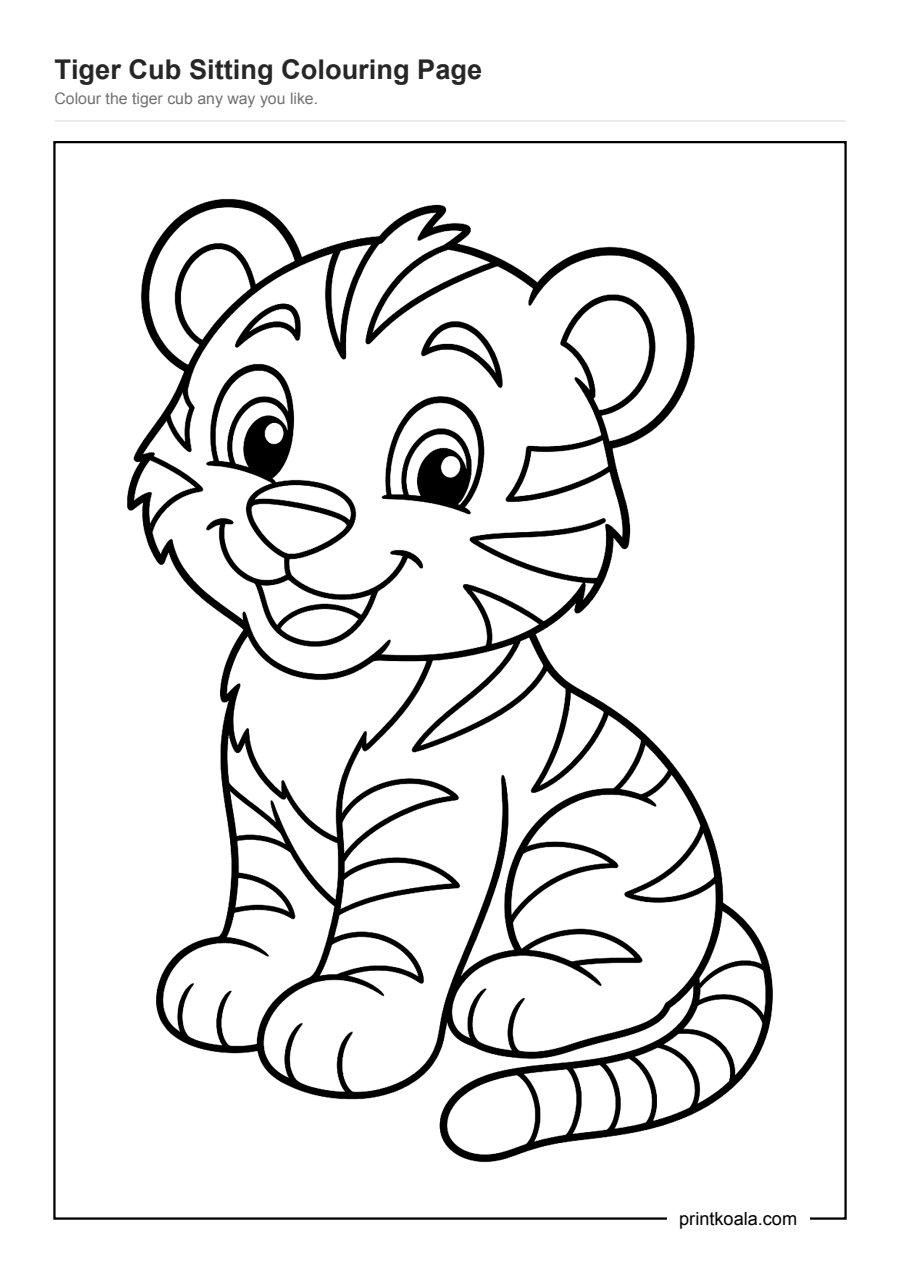
A big-headed tiger cub sits with its front paws on the ground, tail curled round to the front, ready for wide stripes and a happy face.
Free, no sign-up. Downloaded 9 times · A4 · Print at 100% scale
This is a single tiger cub, drawn front-on with an oversized head and a small round body, sitting the way a puppy sits, front paws planted flat on the ground and the striped tail curling forward to rest by its feet. The face takes up most of the page: two big round eyes with a bright highlight dot in each, a small triangle nose, a wide open smile, and three tufts of fur standing up between the rounded ears. Stripes run across the forehead, down both cheeks and along the back, tail and legs, spaced well apart so none of them are fiddly. There is no jungle, grass or background of any kind, just the cub alone on the page.
That open spacing is the whole point of this sheet. The head, the ears, the two front paws and the round body are all big, unbroken shapes a child can fill in without worrying about staying inside a tiny line, while the stripes give slightly older hands a reason to slow down and switch colors. A child can do the whole thing in orange and black and it will look right, or go off-script with purple stripes and a pink nose, since nothing about the drawing insists on realism. The face alone is worth talking about: is the cub laughing, is it about to pounce, what is it looking at.
As a coloring task it sits on the easy side, closer to a first coloring book page than a detailed animal portrait, so it works well for a child who is still building the patience to finish a page. Older preschoolers who like more of a challenge can be pointed toward the narrower stripe bands as a place to slow down and color more carefully. There is nothing here that needs scissors, tracing or a steady enough hand for tiny details, so it also suits a child coloring for the first time.
Let your child start with the head, since it is the biggest shape, then work down to the body, paws and tail. If the stripes feel too fiddly, skip them and color the cub as one solid color instead; the page still works.