🦋 Insects & Little Bugs
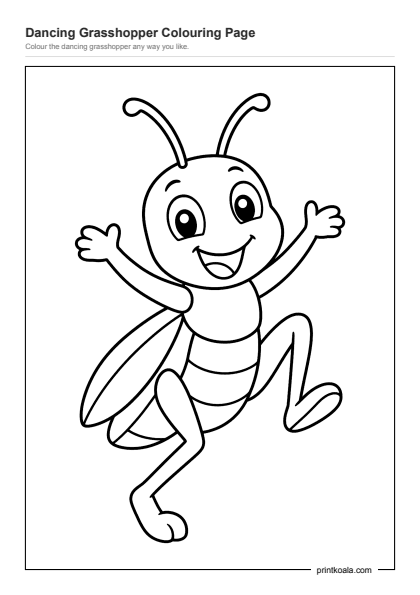
Dancing Grasshopper Coloring Page
Ages 2–56
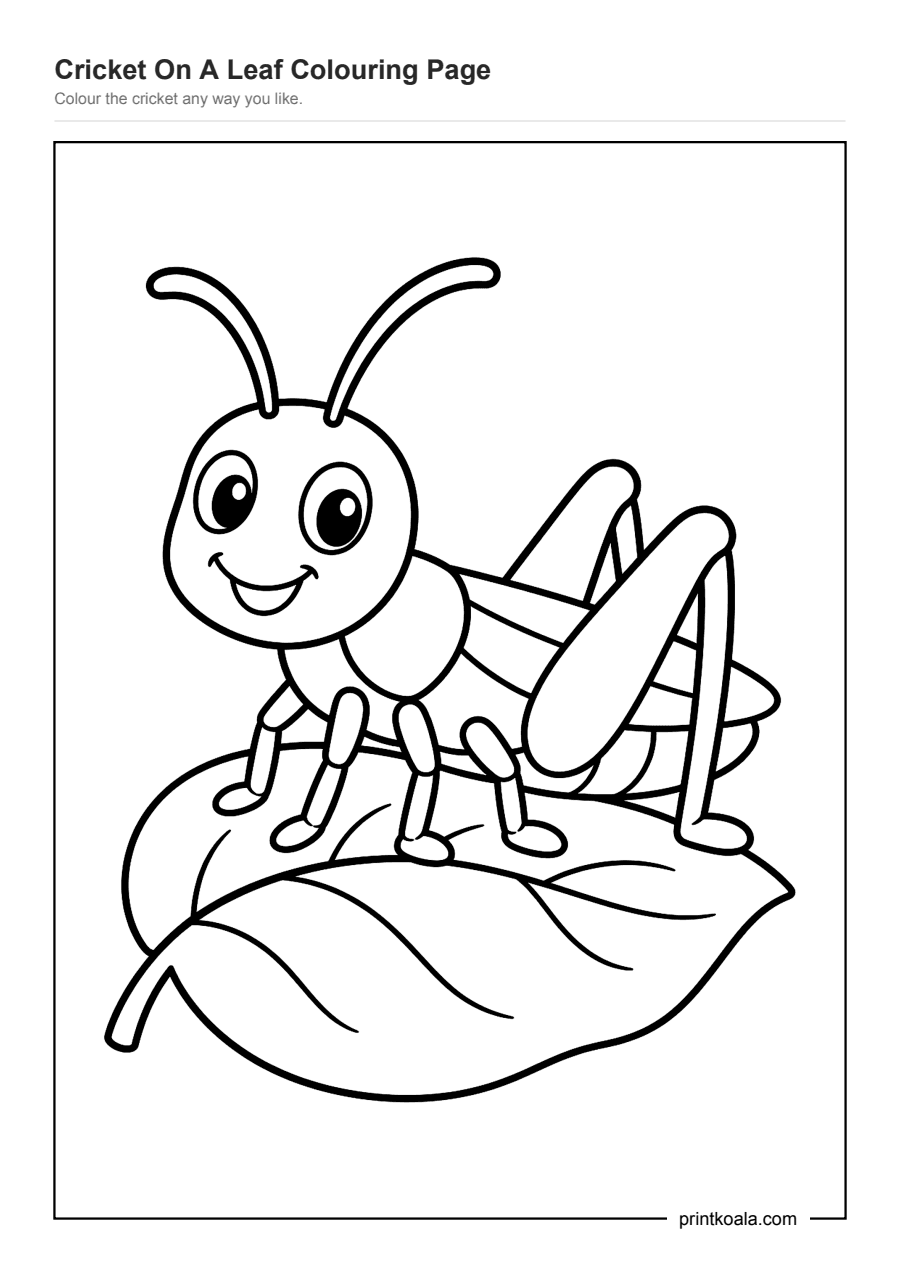
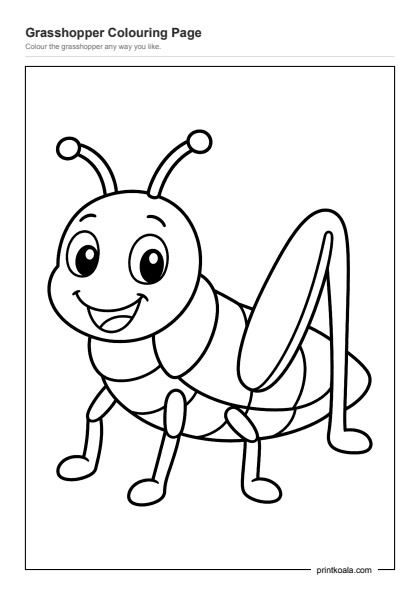
A round-eyed, smiling cricket with big curved hind legs stands on a single veined leaf, ready for coloring.
Free, no sign-up. Downloaded 9 times · A4 · Print at 100% scale
This cricket has a big rounded head with two long curved antennae, two large oval eyes with a white highlight dot in each, and a small curved smile. Its body is one big rounded shape marked with a few curved lines for the wings, and it stands on six legs: four slim front and middle legs and two much bigger hind legs with a chunky oval thigh, the kind real crickets use for jumping. All six feet rest on a single large leaf, drawn with a center vein and slanted side veins and a short curled stem at the bottom left corner.
There is a good mix of shapes to color in here. The head, body and leaf are big, open spaces that a young child can fill in quickly without worrying about staying inside the lines, while the antennae, thin legs and leaf veins are the kind of narrow bits that ask for a slower hand. The two eye highlights are small enough that most children will just leave them white, and that is fine. It is an easy page to talk about while coloring: why crickets have such big back legs, what color a leaf should be, whether this cricket looks happy.
This sits on the easier side of the Insects & Little Bugs sheets, mainly thanks to the leaf's wide, uncluttered surface and the cricket's simple body shapes. The thin legs and antennae add a bit of a challenge, so it suits a child who has colored a few pages before but is still a fair starting point for a first attempt at an insect.
Start with the leaf, since it is the biggest space and builds confidence fast. Save the antennae and thin legs for last, when small hands are warmed up. If the eye highlights get colored over, that is no problem at all.