🦁 Safari & Jungle Animals
Waving Red Panda Coloring Page
Ages 2–510
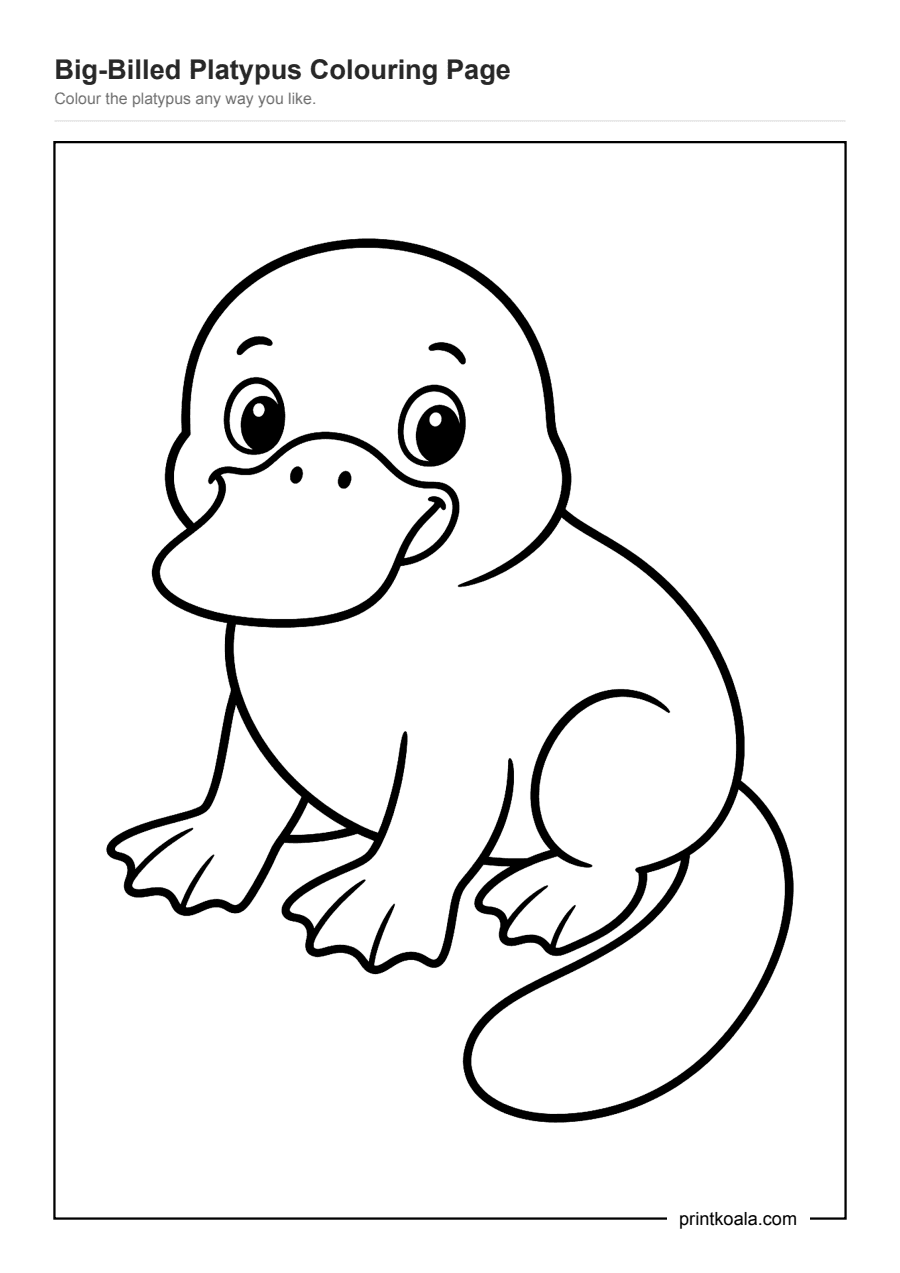
A round platypus sits facing forward with its wide flat bill, big eyes, three fanned webbed feet and a curled paddle tail.
Free, no sign-up. Downloaded 8 times · A4 · Print at 100% scale
This platypus sits square to the viewer with an oversized head, a wide flat bill and two big oval eyes topped with curved eyebrow lines. Two small dots mark its nostrils and a simple curved line gives it a gentle smile. Its plump, rounded body has one curved line marking the hip, and underneath it three webbed feet fan out with clearly separated toes. A smooth, paddle-shaped tail curls out from behind the body and sweeps down to the right. There is no background and no fur texture on this one, just the animal itself in bold, clean outlines.
That mix is what makes the page useful. The bill, head and body are big open shapes a child can fill in fast with a single color, which is satisfying on its own if that is all they want to do. The webbed feet are where the page asks for more care, since each foot has several thin toes close together that need a steadier hand to keep separate. The eyes give a natural spot to pause and talk about the platypus itself, an animal that lays eggs, has a duck-like bill and lives in Australian rivers, which is more unusual than most animals in a jungle or safari set.
Because the large shapes dominate and only the feet demand precision, this sheet sits on the easier end for preschoolers. A three-year-old can happily color the body and bill and leave the toes plain, while a four- or five-year-old is more likely to work right into the fanned webbing and tail. It works well as a first go at a less familiar animal, without asking for the fine motor control that busier, more detailed sheets need.
Start with the bill and body, the biggest shapes, so your child gets a quick win before tackling the trickier webbed feet. The fanned toes are fiddly, so it is fine to color them as one solid foot shape if crayons keep slipping outside the lines.