🦕 Dinosaurs & Prehistoric
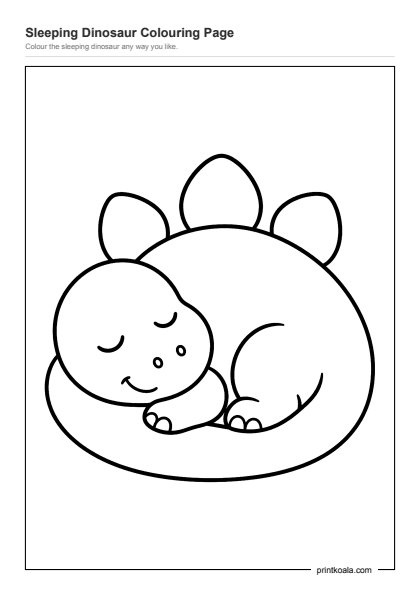
Sleeping Dinosaur Coloring Page
Ages 2–49
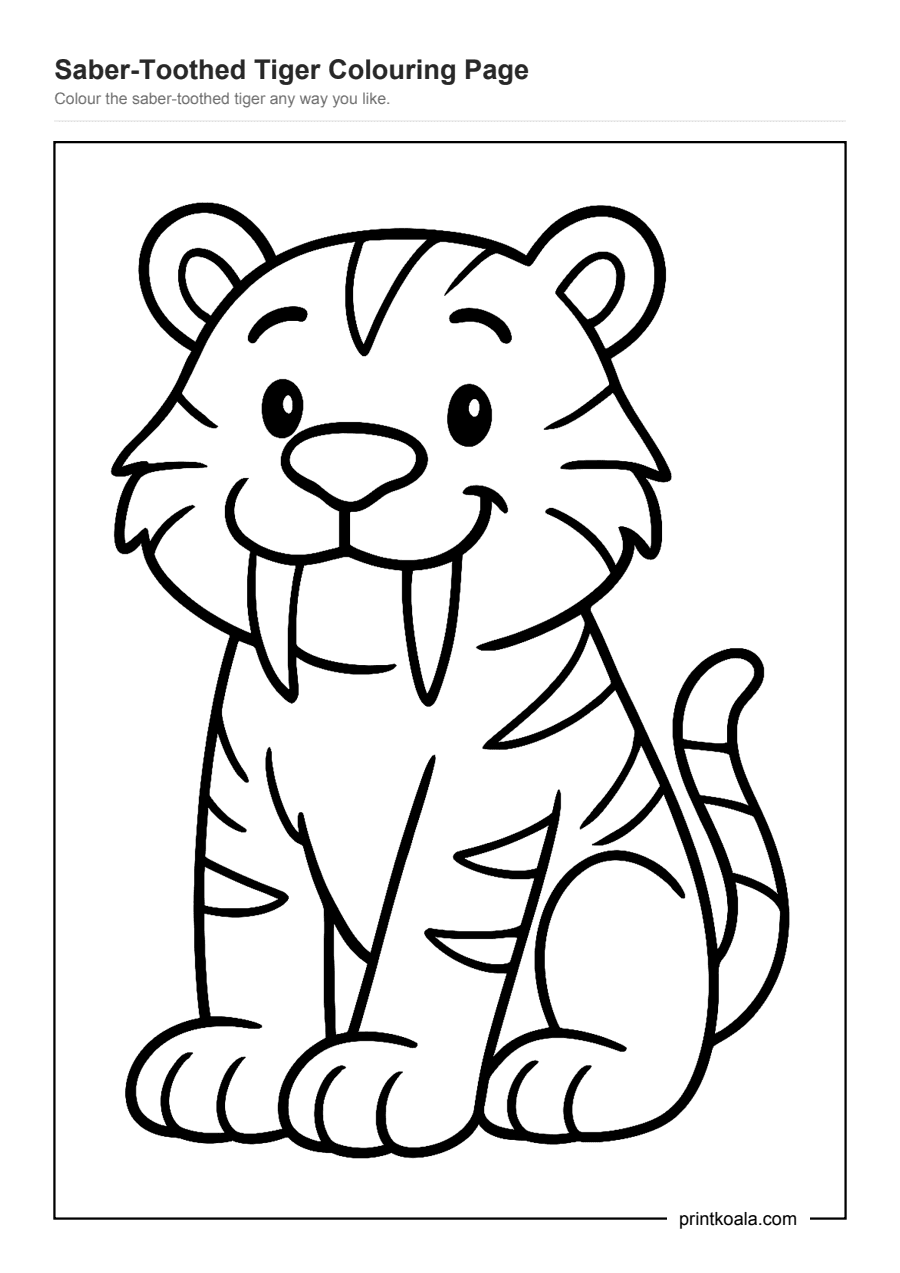
A chubby saber-toothed tiger cub sits facing forward, grinning with two long saber teeth and a curled tail behind it.
Free, no sign-up. Downloaded 10 times · A4 · Print at 100% scale
This sheet shows a plump saber-toothed tiger cub sitting up and facing forward, its paws planted together in front. Its mouth is open in a wide, friendly smile, showing two long curved saber teeth that hang past its chin. A short forehead marking splits into three points between its round eyes, and curved whisker lines fan out from each cheek. The body carries a scatter of curved stripe marks down its back, shoulders and legs, and a short striped tail curls up behind its round haunches.
The drawing gives a child two very different jobs. The head, chest and paws are big open spaces that take broad crayon strokes without much care, while the stripes, ears and saber teeth are small enclosed shapes that ask for a steadier hand and a finer tip. Because the teeth are the one properly prehistoric detail on an otherwise cuddly-looking cub, they are a natural thing to point at and talk about — long sharp teeth on such a friendly face is exactly the kind of contrast that gets a four-year-old asking questions.
It sits in the middle of the difficulty range for this age group: nowhere near as fiddly as a busy scene, but the stripe marks and pointed teeth make it a step up from the roundest, simplest animal outlines. It suits a three-year-old coloring loosely in big blocks, and gives an older four- or five-year-old enough small shapes to slow down and color carefully.
Let your child start with the big belly and paws before tackling the small stripe marks and teeth, which need a steadier hand. If the saber teeth feel too fiddly, leave them white — the smile still reads as friendly either way.