🦁 Safari & Jungle Animals
Lion with a Big Fluffy Mane Coloring Page
Ages 3–516
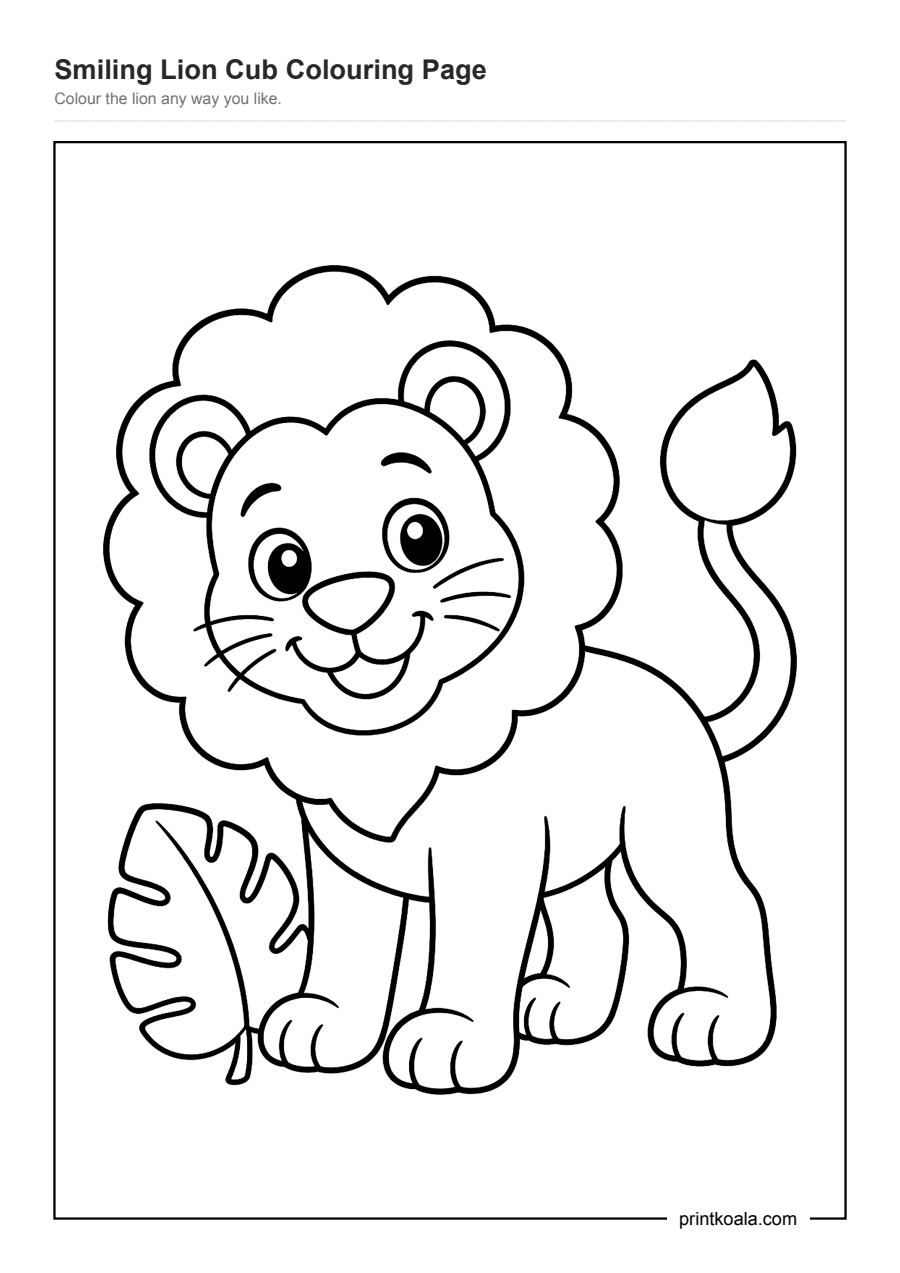
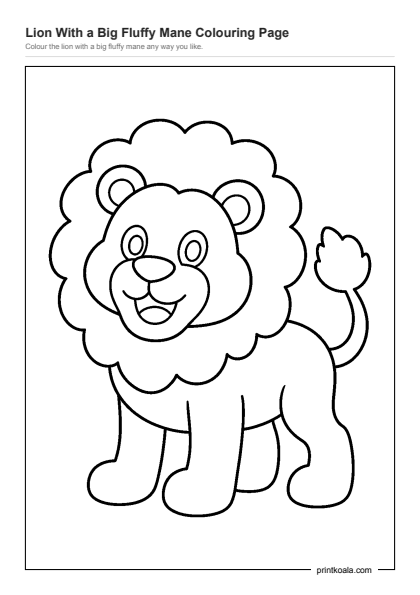
A cheerful lion cub stands beside a single jungle leaf, its big fluffy mane made of large scalloped bumps ready to color.
Free, no sign-up. Downloaded 11 times · A4 · Print at 100% scale
This lion cub stands on all fours with its head turned to face you, mouth open in a happy smile. Its mane is drawn as a ring of big rounded scallops circling the face, and behind it a long tail curls up and over with a tufted end. Down at the front paws sits one large jungle leaf with notched edges, the only other object on the page. Look closer and there are smaller details too: two round ears with a curl inside each, big eyes with a bright highlight dot, a triangle nose, and whiskers fanning out three to a side.
The mane is the main event. Those scalloped bumps are large enough for little hands to fill in one at a time without much fuss, and a child can decide whether every scallop matches or whether the mane turns into a patchwork of colors. The body, legs and tail are equally roomy, so most of the page is the kind of easy, low-pressure coloring that builds confidence rather than testing it. The leaf and the small face features are the only spots that call for a steadier hand, which makes a nice change of pace within the same picture.
Compared with other sheets in the safari set, this one leans easy rather than fiddly. There is nothing tiny to fight with except the whiskers and the curls inside the ears, so it works well for a child who is just starting to stay inside the lines, while the mane's scallop pattern gives an older preschooler something to think about too.
Let your child start with the big mane scallops before moving to the body and tail, saving the whiskers and ear curls for last since those need the steadiest hand. If the mane feels repetitive, suggest alternating two or three colors around the ring.