🦁 Safari & Jungle Animals
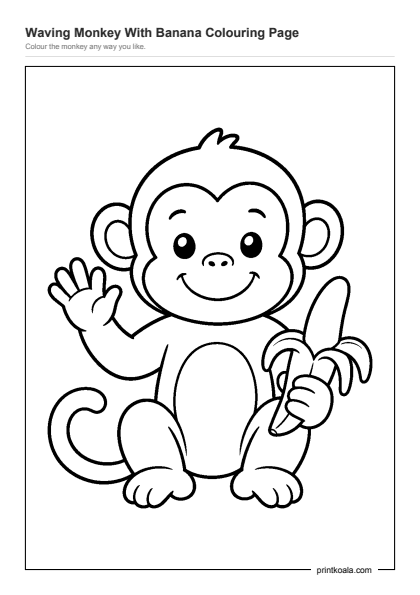
Waving Monkey with Banana Coloring Page
Ages 2–414
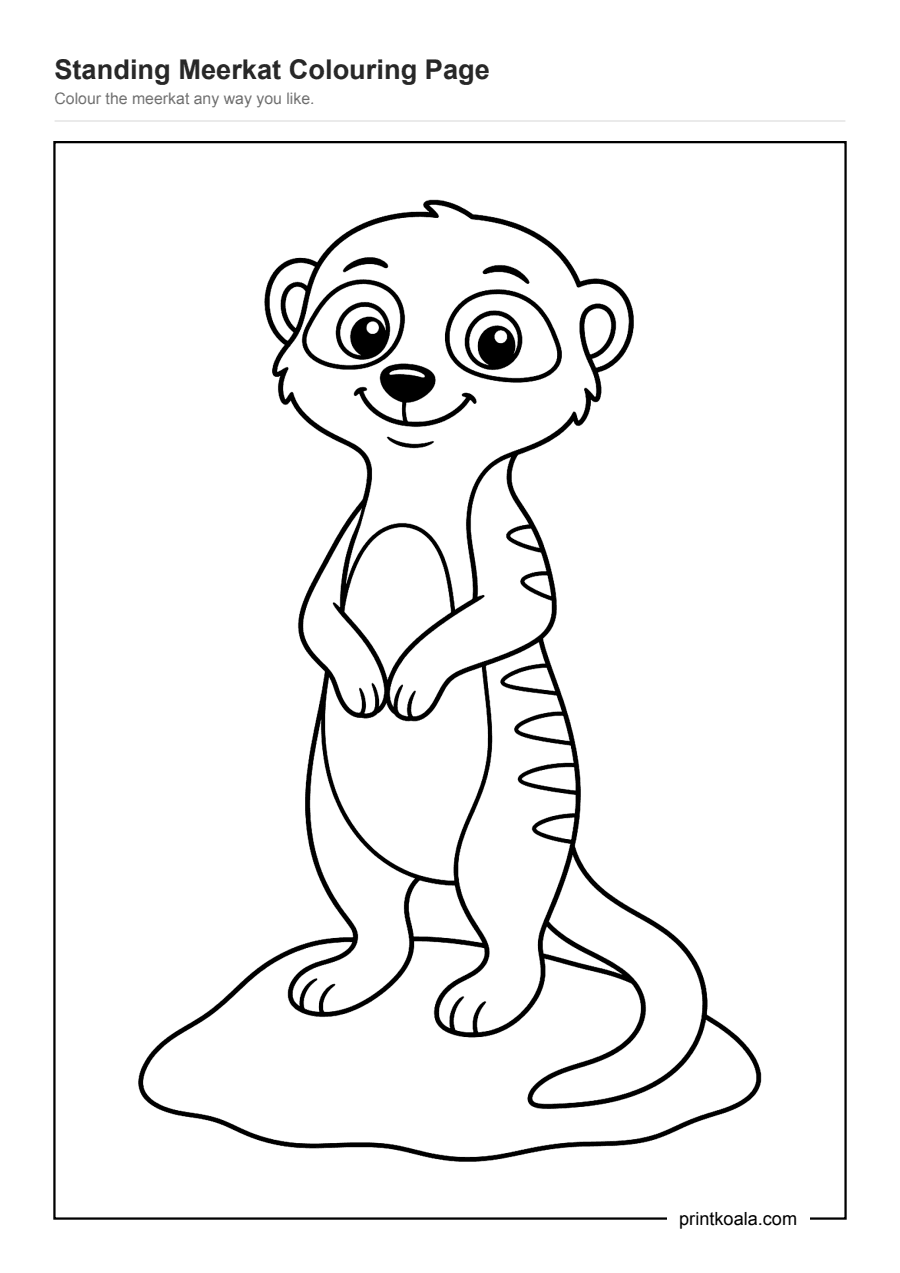
A meerkat stands tall on its back legs with front paws clasped together, a striped back and a long curled tail.
Free, no sign-up. Downloaded 9 times · A4 · Print at 100% scale
This meerkat stands the way meerkats really do: upright on two legs, front paws clasped together over its round belly, head tipped slightly and smiling out at the page. Its face has two big round eyes, each sitting inside a dark patch, small rounded ears, and a little button nose. Down its back and along the thick tail runs a row of small curved stripe marks, and the tail curls round to rest on a simple mound of ground underneath its feet.
The drawing gives a child two very different jobs, which is what makes it satisfying rather than tedious. The head, chest, belly and tail are all big, rounded, forgiving shapes, so a child can color fast and still stay inside the lines. Then the row of back stripes and the eye patches ask for a slower, careful hand in a small space, which is good practice once the big areas are done. It is also an easy one to talk about while coloring: meerkats stand up like this to keep watch for their family, which is exactly the pose on the page.
Overall this sits on the easier side of the animal sheets in this set. The outlines are clean and not too fussy, and there is nothing tiny that needs a fine-tip pen. It suits a child who is just getting comfortable holding crayons inside a line, with the stripe row there for anyone who wants a bit more of a challenge once the easy parts are done.
Start with the big belly, chest and head so your child gets an early win, then move to the fiddlier back stripes and eye patches last. If the stripes feel too small, skipping them or filling them in with one quick color is fine.